
Hi! I’m Rob Snyder, founder and product-market fit advisor.
This newsletter + my podcast and book explore product-market fit.
I also run PMF workshops to help teams figure out PMF+GTM fast. Already quite booked for Q4, so learn more and reach out here.
Also building “AI Rob” (which reviews your deals + outbound like I do) - it is in ugly beta, get a free month HERE.
If you’re new here: Intro to PULL theory
Most people, most of the time, would be crazy to buy our product - even if they have big pain points and we offer them a ton of value. Buying any specific thing is weird and rare; in almost all situations, a person would have to drop their priorities to buy our product. Or they’d have to buy our product despite having good-enough current tools, methods, or options to get their current priority done.
The PULL framework describes a person who’d be crazy not to buy our product right now: This person has a project that’s unavoidable, where their existing options aren’t good enough to get their project done. When someone has PULL, they rip something that unblocks their project out of our hands. In other words, PULL causes sales. If they don’t have PULL, or if they do have PULL but we don’t offer something that unblocks their project, it would be weird if they bought from us.
PULL is found, not created. PULL makes startups take off, as long as they design everything (product, GTM, team) around PULL.
Today’s topic:
In a conversation with a potential customer, you either find PULL or you don’t. But if you don’t find PULL, that doesn’t mean it wasn’t there to be found.
Most sales calls I watch don’t bother looking for PULL, and instead ask:
Current-state questions: “Tell me about your current workflow, team, pain points, etc.” These questions give you random trivia facts.
Ideal-state questions: “If you waved a magic wand, how would X workflow work?” Or “How would the ideal product work for Y workflow?” These questions are perfectly designed to confuse us - someone pontificates about how a workflow would ideally work while having no intention to do anything about that workflow.
Qualification questions: “How is this decision going to be made? Do you have budget?” Unless you have found PULL, these questions are annoying: “What decision? A budget for what exactly?”
All this leads to a confusing mess where we learn nothing useful while feeling like we’ve maybe learned something useful. We pitch our product, and sometimes they buy, but it feels unpredictable and random. Causality is there to be found, but without the PULL framework, we won’t find it.
When we’re looking for PULL, we’re looking for what they are trying to do! Which takes two forms:
What are they trying to do right now, but can’t do with their current tools, methods, team, etc. - such that they’d buy something right now?
What would they do right now if only there was a way - such that they’d buy something right now?
Even when we try to look for PULL, I find that a lot of founders get tongue-tied, not knowing the exact words to surface PULL.
This post gives you exactly 37 questions/methods for looking for PULL in a conversation with a potential customer.
The most common antipattern when looking for PULL
When we get started looking for PULL, we tend to make one big mistake. Because PULL is an acronym with four letters, we tend to think we need to fill out the acronym sequentially: Start with P, and work our way to U, then L1, then L2.
So we start with a question like: “What are you prioritizing in the next 3-6 months?”
We get an answer then dutifully follow up with:
Why is this urgent or unavoidable?
What options have you looked into for getting this done?
Why aren’t these options good enough?
But here’s the problem with this approach: Most of their projects/priorities don’t need our help getting done. For any given P, it’s unlikely that ULL also exist. Think of a product team’s roadmap: Almost everything on it is “stuff we’re totally fine getting done with our existing team and agents.” This is PUL - an unavoidable project with a good-enough option. When they have PUL, they don’t buy. When they have PULL, they do.
So if we ask about P, then try to fill out the rest of the framework, we by default get P where there is no ULL. And we waste precious time in a customer conversation to learn that this is not PULL.
All of this means you have to ask about PULL in its entirety, as one thing. PULL is one thing, not four things.
How to look for PULL
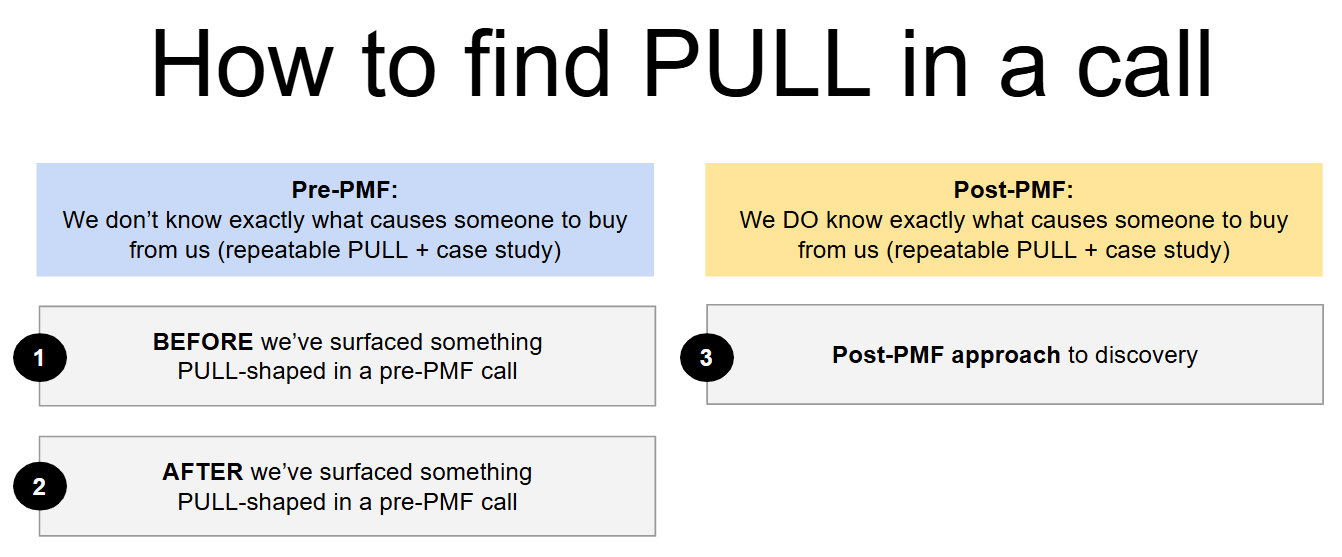
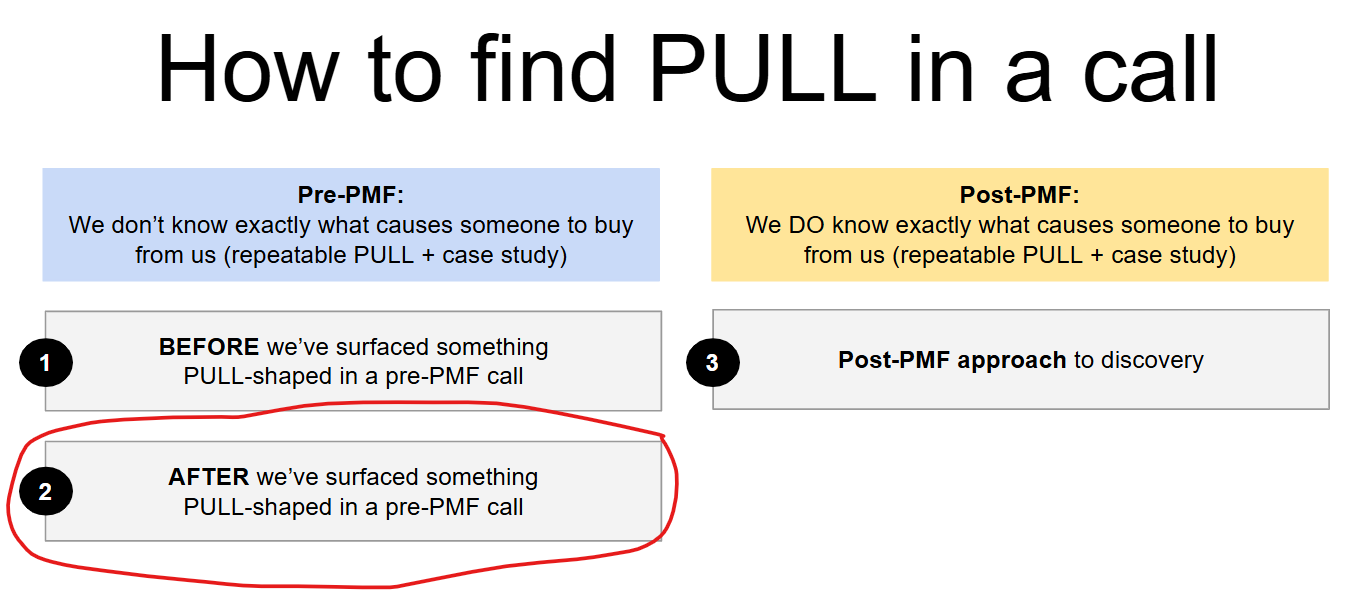
Your approach to looking for PULL depends on where you are in your product-market fit journey, and where you are in a specific call. I have three different playbooks below:
Pre-PMF, before you’ve surfaced something “PULL-shaped” in a call
Pre-PMF, after you’ve surfaced something “PULL-shaped” in a call
Post-PMF, ways of approaching discovery
“Uh… what does PULL-shaped mean?”
A “PULL-shaped” thing has the core elements of PULL, but is usually fairly rough or abstract: “Yeah, we’ve got all these product bets we’re trying to make, but don’t have enough research capacity, and so we’re looking for any way to fix that.” This is not precise, but it seems like the elements of trying-right-now-but-blocked are there. So you have something PULL-shaped, but you’ll need to dig in to understand what these words mean!
1 - Pre-PMF, BEFORE we’ve surfaced anything PULL-shaped
We are here:
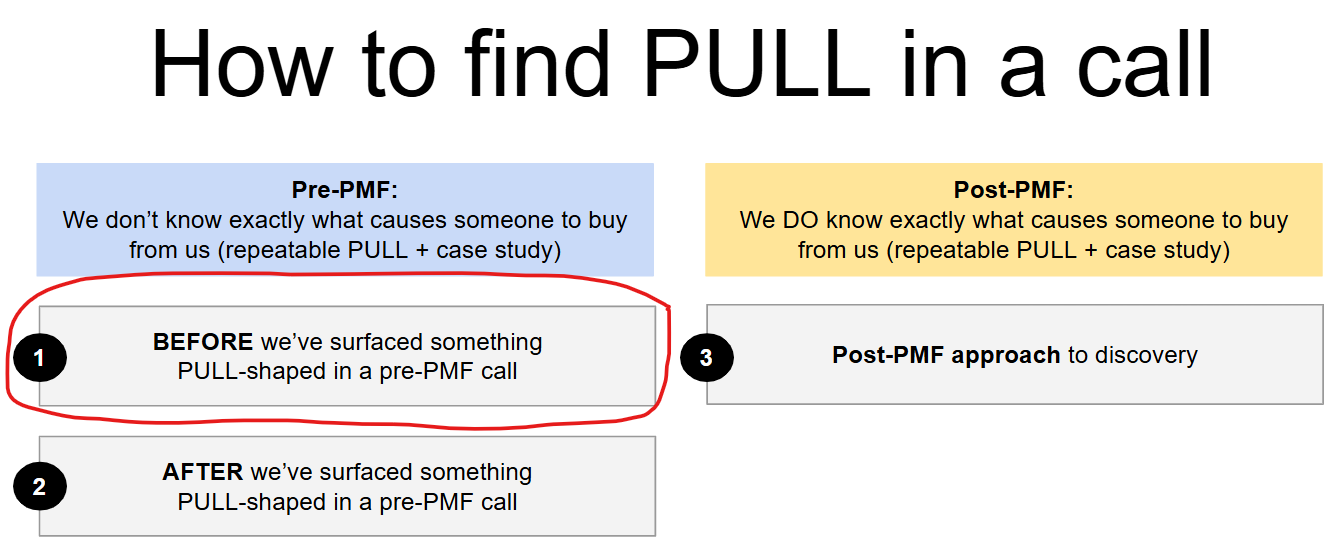
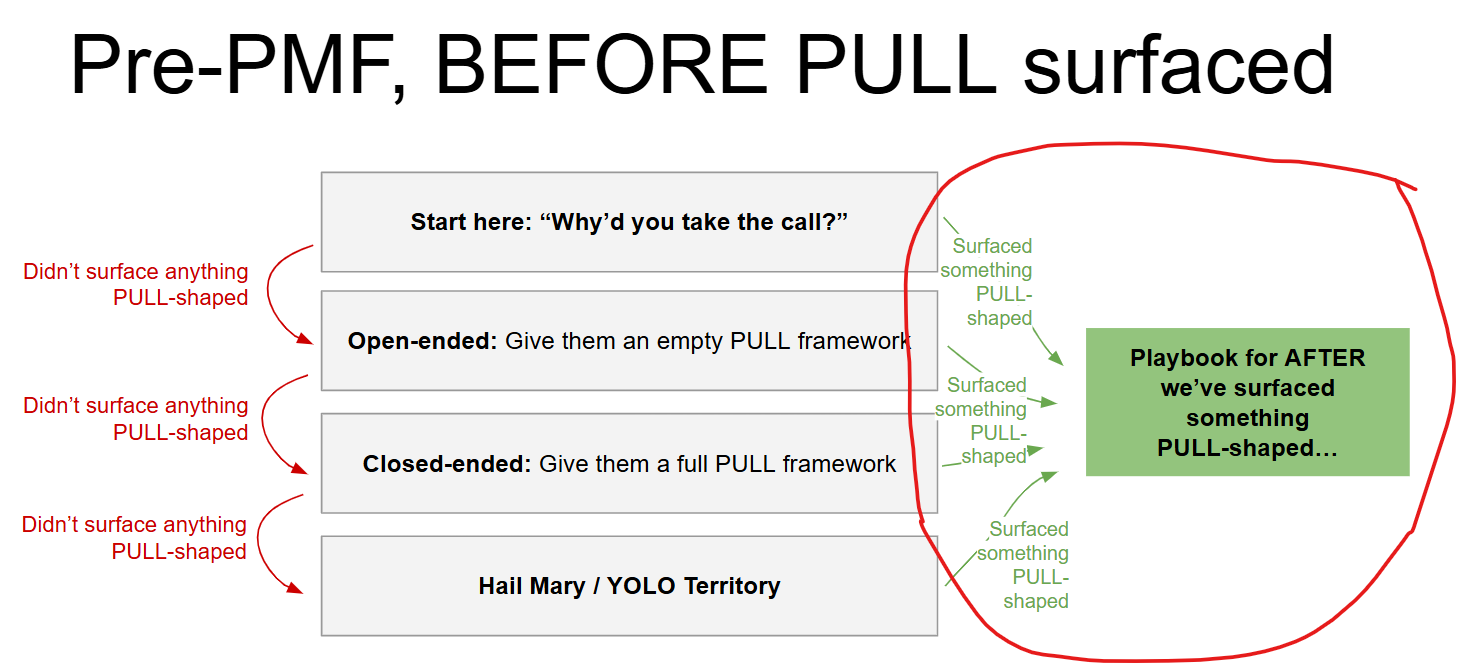
Every call starts here, even if they’ve come inbound and filled out a fancy intake form. Our goal is to get them to explain their PULL, so we can know what to offer that they’ll rip out of our hands.
Here’s my standard approach, which gives you multiple chances to surface PULL if the first doesn’t work:
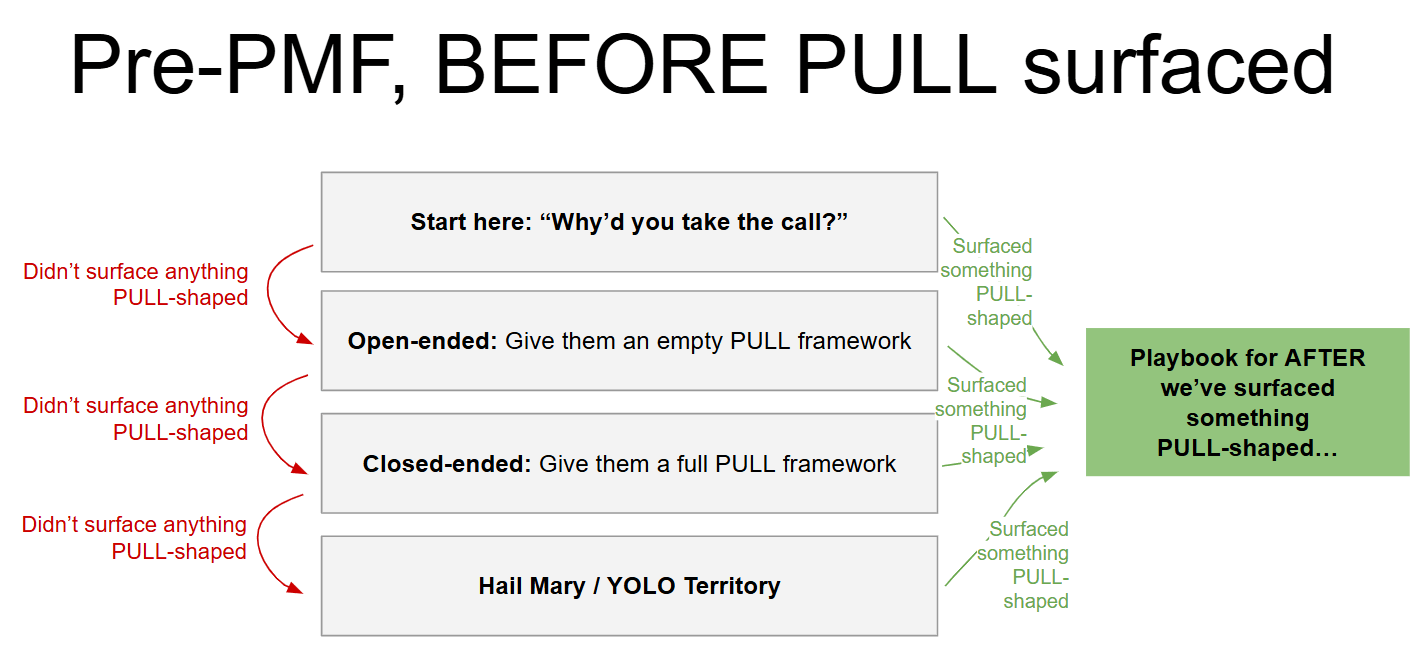
Attempt 1: “Why did you take the call?”
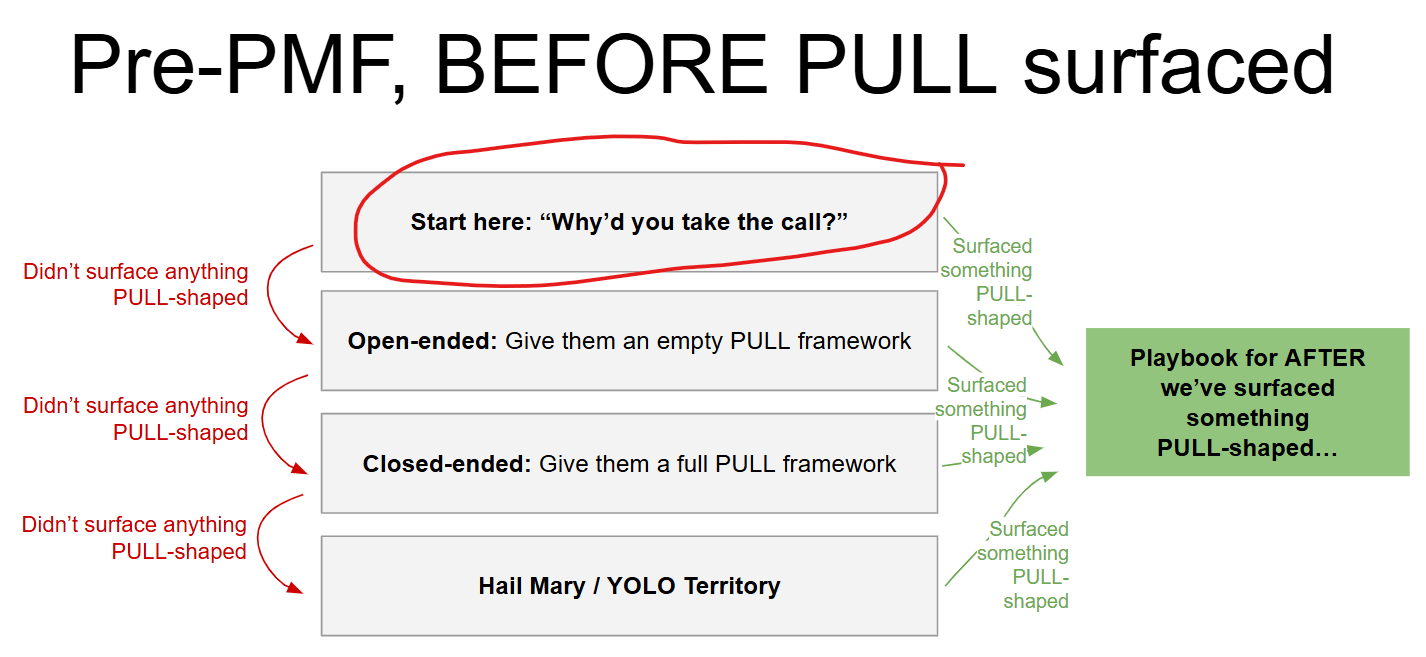
This is a required question at the beginning of a call. It gives them the opportunity to explain what they’re hoping to get out of a conversation with you.
Variants of this question:
I’m sure you get a bunch of people reaching out to you; why did you decide to take the call with me?
Was there something specific in my message that stood out to you as relevant to what you’re working on?
I know Josh made the intro, but was there anything in the message he sent that stood out as potentially relevant to you?
(From an exec coach) What is the highest purpose of our conversation today?1
(If inbound) You booked a meeting on our website - was there anything in particular on our website that stood out as relevant to you that caused you to want to meet with us today?
(If inbound) Why did you reach out to schedule the call with me today?
(If inbound) I saw your input form, but was there anything particularly on your mind today?
The next step after asking this question is to align on an agenda for the call, then earn the right to ask additional questions (see “How to start a sales call.”) After this, you either proceed to Fallback 1 or to Post-PULL.
Fallback 1 - The Open-Ended PULL Question
“As it relates to [your QA process], is there something in particular you’re trying to solve right now you’re hoping someone could help with?”
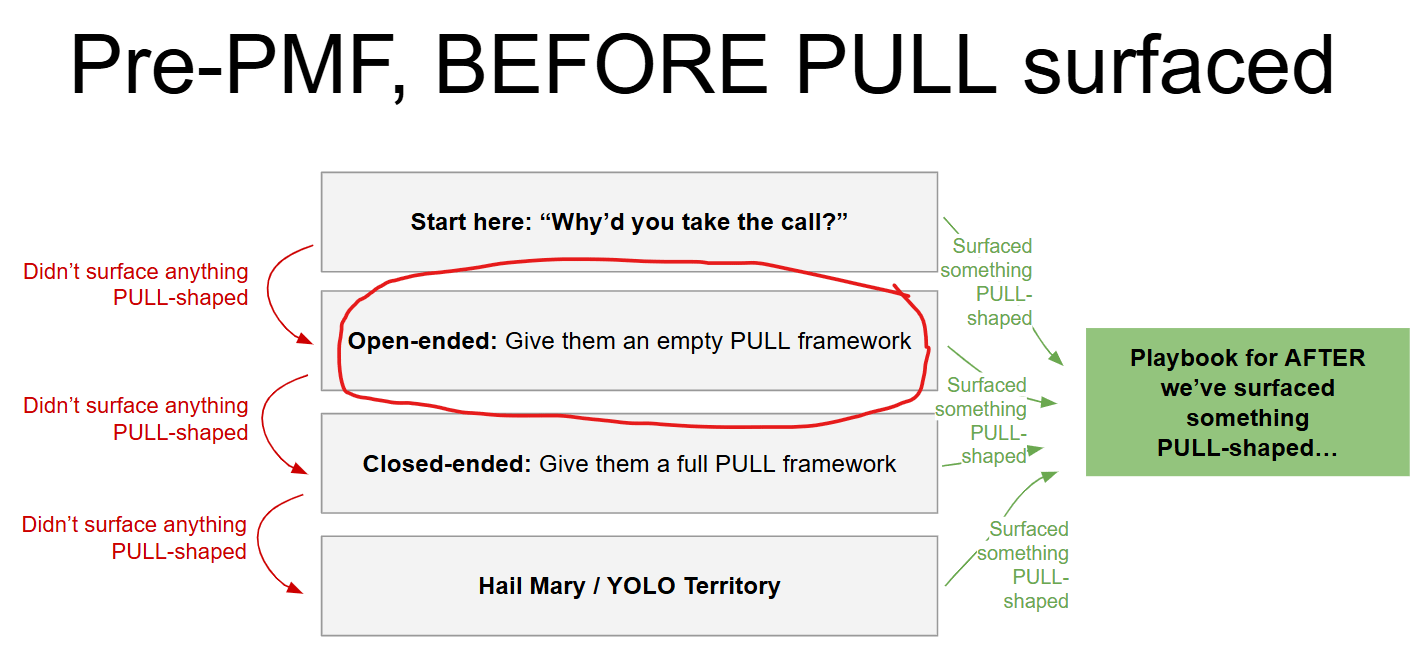
You can see how this question is different from the antipattern question - “what are you prioritizing right now?” - which only asks about P+U. This question asks about all of PULL at once:
As it relates to [your QA process], is there something in particular you’re trying to solve right now you’re hoping someone could help with?"
Key: PULL
Variants of the Open-Ended PULL Question:
What areas of the business are you looking at and how might I be able to help?
Is there something specific you’re looking for help with?
Is there something on your to-do list as it relates to [QA] that you haven’t been able to get done?
What, if anything, needs to change in the next quarter? Anything in particular that you don’t feel like you’re set with your existing team and vendors?
Are there any gaps on your mind that you need help closing as it relates to [QA]?
I’m sure you’re all set - but is there anything you’ve been trying to do [in QA] that you’ve not been able to accomplish?
The point is just to fit all of the PULL framework into a single question, essentially giving them an empty PULL framework and seeing if they fill it out.
Fallback 2 - The Closed-Ended PULL Question
“Usually when I talk with [CTOs], they often say they are trying to get E2E testing off their team’s plate, but wind up with an engineer spending a ton of time in Claude + Playwright. Is that not something on your mind right now?”
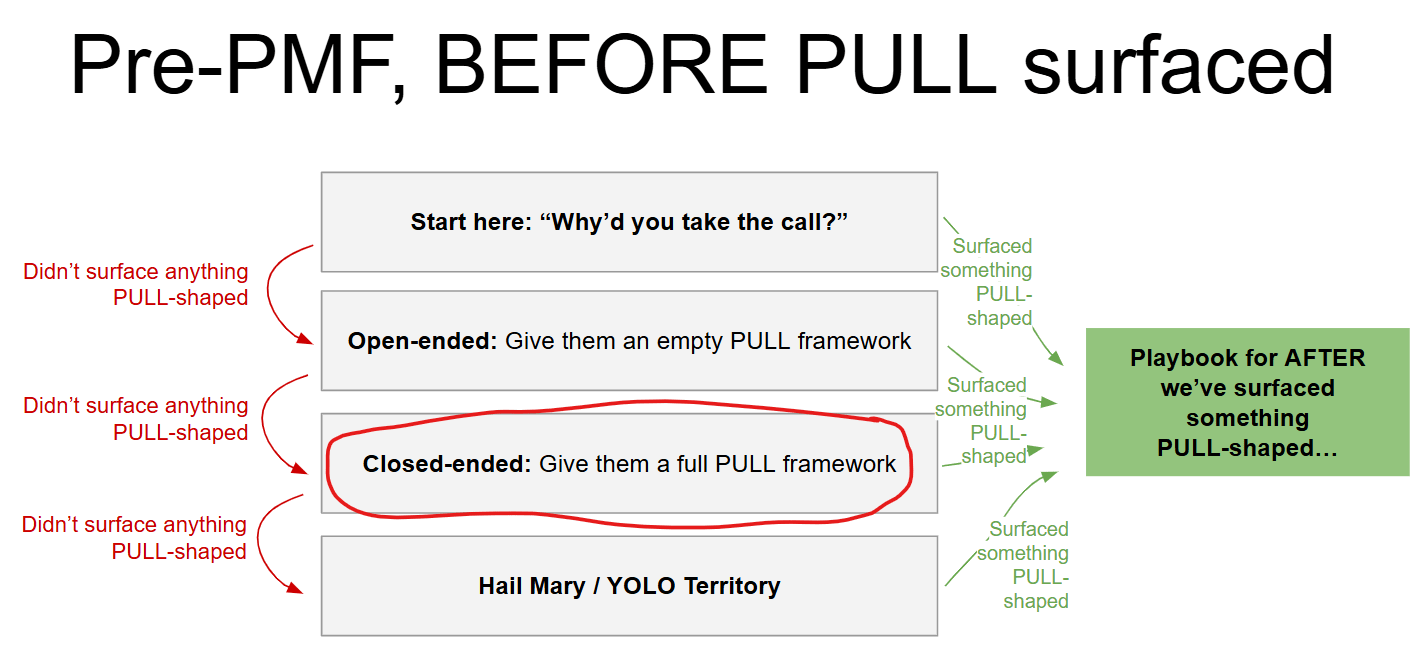
This question puts your PULL anecdote front-and-center, and asks them to tell you why it’s not relevant to them.
Other variants of this kind of question:
[Show quotes from your PULL anecdote on a slide] - Not sure if this resonates at all with you, or if this is totally irrelevant?
I was just talking with [a CTO friend here in New Hampshire] - who was complaining about being stuck using Claude + Playwright for E2E testing and wondering why E2E testing couldn’t be fully automated. I don’t know if you’re struggling with that or if you already solved it?
When I was at [my last company], I desperately wanted to find someone or something to help me do X without Y… hearing a few CTOs say the same thing, but I’m curious if that’s what you’ve run into?
Fallback 3 - The Hail Mary
“Is there anything you’d pay someone right now to help you solve or accomplish?”
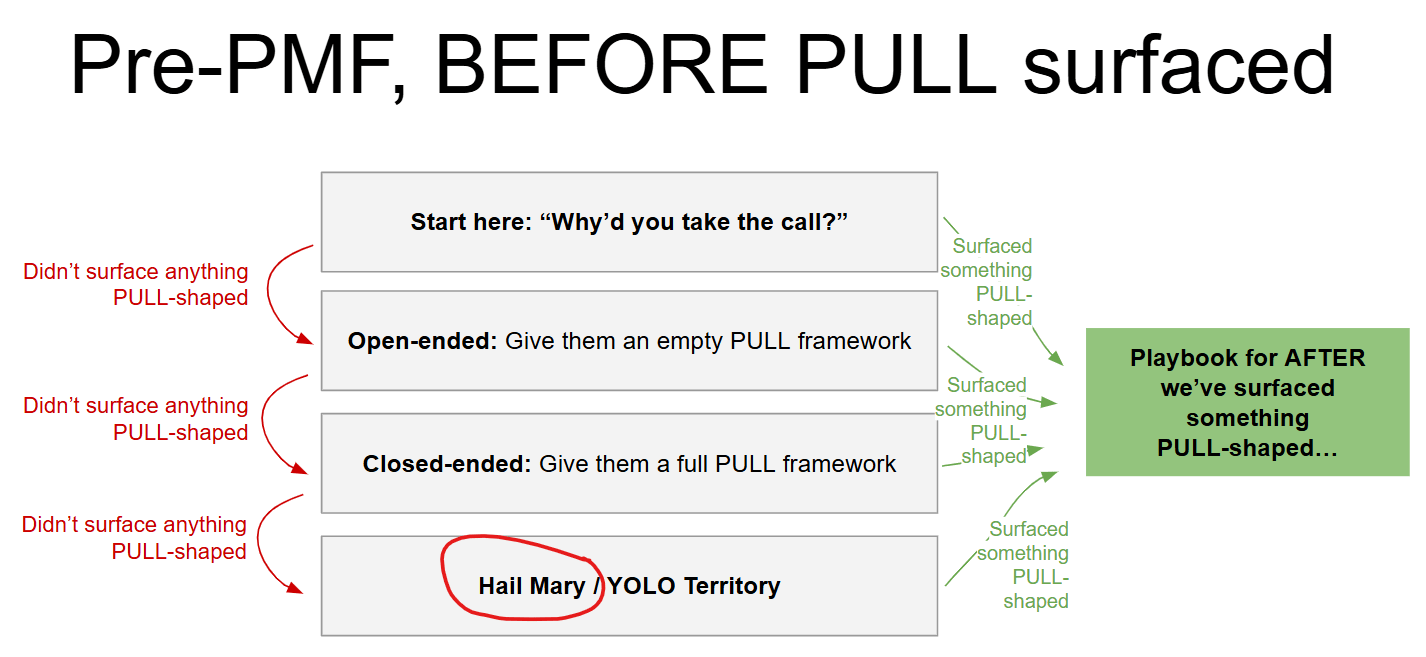
Here we enter YOLO territory. If the above hasn’t produced anything, it might not be there. And so we’re just looking for some sort of PULL by any means necessary. The Hail Mary approach has actually surfaced things that turn into fast-growing startups, but it
Other versions:
So it doesn’t sound like there’s anything you’re needing help with now.
What did you come to this conference to buy that you haven’t found?
Is there any vendor you’d switch out right now if a better option was available?
Fallback 4 - FULL YOLO
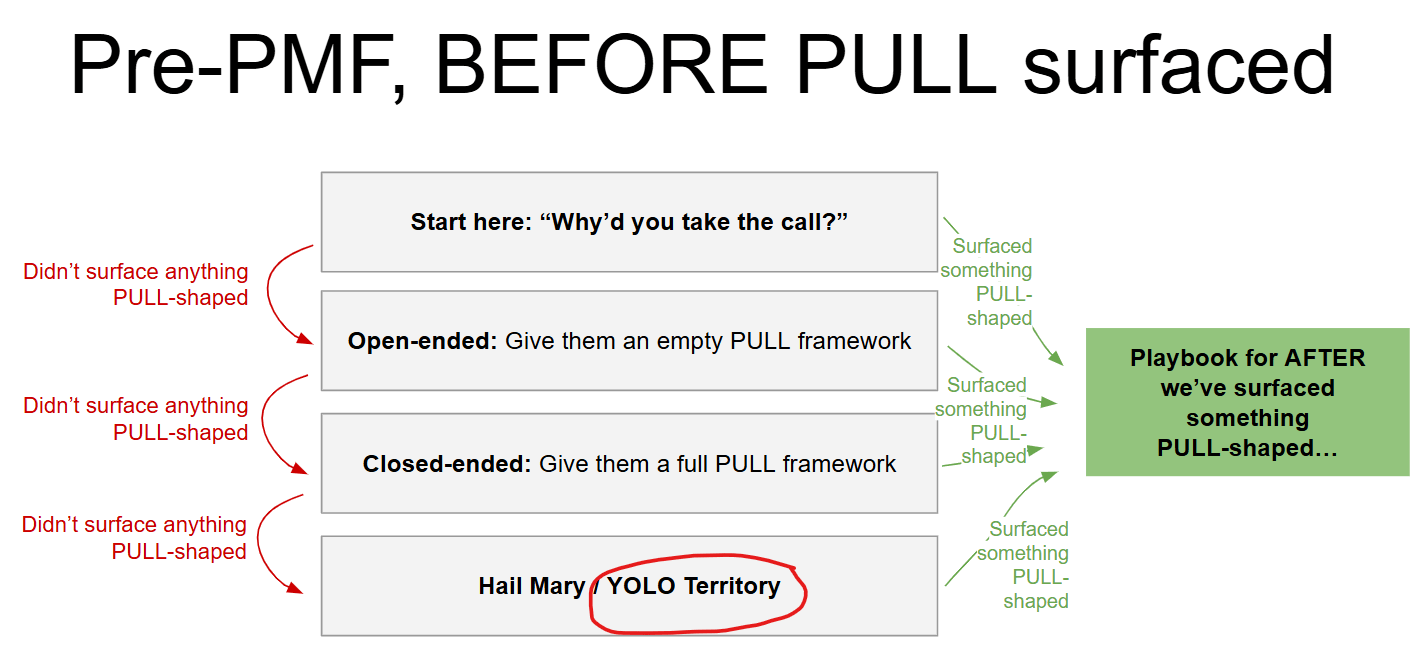
FULL YOLO means showing your product, demo, website, etc. to see if any synapse fires in your potential customer’s brain. I have never seen this happen on a call, but SOMETIMES you get an email a few days later that says: “You know, I just was thinking about your product, and realized that maybe it could work for XYZ project we’ve been trying to get done. Can you help with that?”
If you don’t want to go FULL YOLO, you can just end the call early with a polite: “Cool, well I don’t want to waste your time as it seems like what I’m working on is pretty irrelevant - at a high level it does XYZ, but sounds like that’s zero percent helpful to you. Happy to reconnect if anything changes!”
And then: “By the way, does anyone in particular come to mind in your network who might be struggling with ABC?”
Post-PULL - We surfaced something PULL-shaped
Woohoo, they said something PULL-shaped!
Engage next playbook:
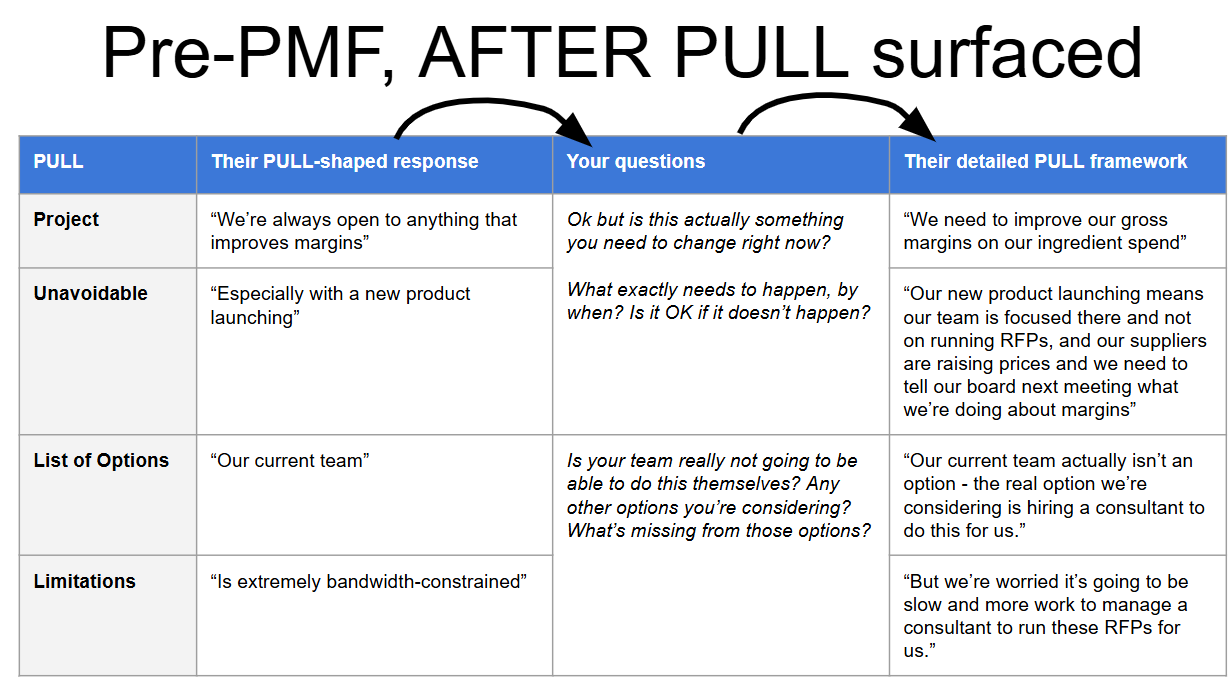
The goal of this stage is to FILL OUT THE PULL FRAMEWORK IN DETAIL:
I’ve found two useful principles for this stage:
Inversion helps you fill out the PULL framework in detail and testing it at the same time - instead of asking, “Why is it urgent?” ask, “Is that something you actually have to take action on? Why not wait and do it next year?”
Playing dumb prevents you from coming across like an interrogator - instead of saying, “Tell me the exact project on your to-do list”, ask, “Maybe I missed it - can you help me understand exactly what your desired outcome looks like?”2
Examples:
“Can you help me understand why [doing this yourself with Claude Code] isn’t an option?”
“So you tried this with Claude Code - why wasn’t that good enough?”
“There isn’t a hard deadline for solving this, is there?”
“Maybe I’m not understanding this - what exactly is the thing you’re trying to do that you can’t do here?”
Post-PMF
Ok… but what if you have your repeatable case study? At this stage you are running a compression algorithm on your entire GTM motion, including discovery.
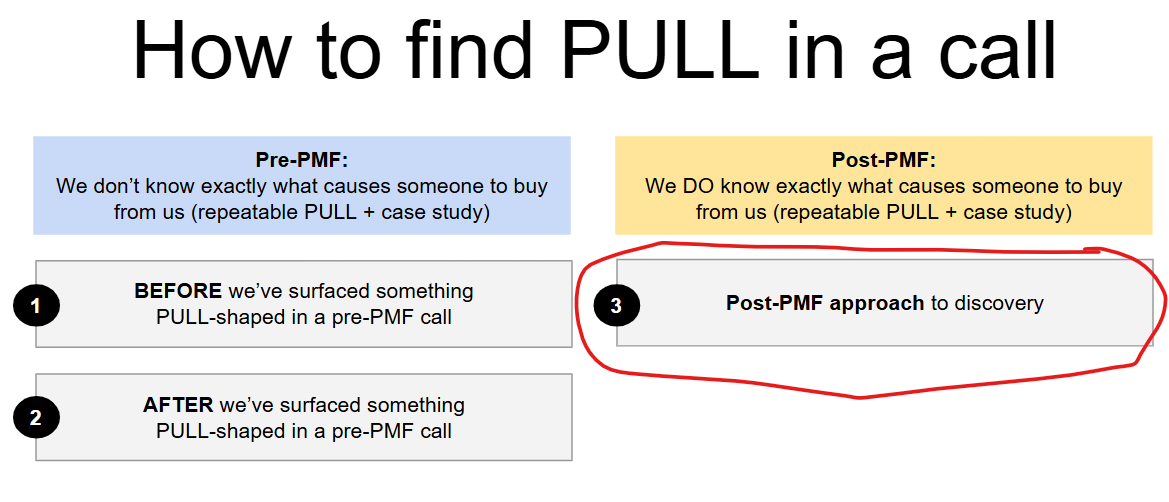
This means you’re almost certainly going to tweak your approach to insert hyper-specific discovery and qualification questions. Your goal is to surface the exact kind of PULL you serve as efficiently as possible. If PULL is not there, these questions are designed for you to learn this ASAP so you can end the call as quickly as possible and not waste time on people who don’t have PULL.
Your approach here - just like your Toll Booth - is going to be custom to the PULL you’ve found. Here are a few examples I’ve seen:
A friend’s startup has four very pointed questions which give them ~90% certainty that a person will buy. The startup’s questions are unique to the PULL they’ve found - these are roughly their questions (but doctored):
Why did you take the call? What about our message stood out?
Why did you leave McKinsey to start your own consulting firm?
What do you miss most about your time at McKinsey?
What are you doing about that today?
Another startup shows a slide at the start of their call that talks through a bunch of different tasks their agent can automate - and uses that to start the conversation: “Does anything here stand out as something you’re trying to get off your plate?”
Depending on your pipeline source (e.g., Google ads on “alternative to [competitor]”), you may just jump straight to: “So my understanding is you’re looking into Onboarding Software options. What stage are you at in the decision-making process, what have you looked into, and how can I help?”
I don’t think these make sense to do before you’ve found PULL/PMF… but hey, your mileage may vary.
Bonus: “Break glass” ideas to find PULL when all else fails
Some of you will say, “Ok, I haven’t found PULL and I’ve done like 10-100 calls. What are some even crazier moves for desperate people who just want to find SOMETHING?”
Throwaway supply to find the real PULL: Try to sell the wrong thing, knowing it’s the wrong thing, with the sole intention not to sell the wrong thing but to have them tell you what the right thing is. Most of us sell the wrong thing to figure out what the right thing is unintentionally.
Offer a super cheap consulting service: A startup I know offered insurance brokers “we’ll fly out to you, automate whatever you want and give you the automations for $500” - ridiculous offer, but a way to figure out what they’d pay to automate, that they then turned into an AI product and are growing fast now.
Follow the objection: If you find you’re hearing the same objection (e.g., this isn’t a priority for us right now), use that as signal - for whom would it be weird if this wasn’t a priority right now?
Go to the Gemba: All else fails, go firsthand and shadow your potential customers, do the job with them and surface PULL that way!
Got other ways you surface PULL in customer conversations? Send them to me, and I’ll add them to the list!
I thought about asking this once, but chickened out.
Fortunately for me, I am a NATURAL at playing dumb. Some would say I don’t have to act at all.