
Blocked or coping?
Two flavors of PULL
Pre-order my book, The Power of PULL - it’s coming out July 7!
This week’s podcast:
When startups take off, it’s not because they convince a people to want their product. Startups that take off find people who are “sold” BEFORE they know that the startup & product exists.
If you watch these startups’ sales calls - even before these startups become known brands - you see virtually ZERO convincing or persuasion. Prospective customers “get it” and buy, basically instantly. This seems like sorcery. Two startups might follow the exact same sales methodology - yet one startup closes and the other doesn’t. The successful, fast-growing startups have all found PULL: People who are trying to accomplish something right now, but their current methods aren’t good enough. The tension between “the thing I’m trying to accomplish” and “the ways I can accomplish it” is what generates the energy to purchase something new. It’s what causes a person to be sold on the startup’s product before they even know about the startup or the product - the second they hear about it, they try to buy it.
The most important unlock in all of this is being able to see the “demand side” as a totally separate thing from the “supply side”. The supply side is about all the things we control - our product, messaging, GTM tactics, you name it. This is what we focus on by default. We iterate on our messaging and product, thinking that “if we just get these things right, buyers will want it.” Yet when we do this, we miss the thing that causes messaging and product to work. This is found on the demand side, which we don’t control, and exists independently of us. The demand side is where you find PULL. The supply side is where you describe something that fits PULL.
This week, I’m adding a bit of color to my PULL framework - two flavors of PULL that I’ve seen that cause startups to take off. The prerequisite to building something that takes off is finding someone who was blocked or massively coping before we existed.
The Trello Board in their SOUL
Imagine you can see a potential customer’s to-do list right now - the “Trello board in their soul.” I imagine everyone has a Trello board with four categories of projects:1
Backlog of things I’d like to eventually prioritize (no PULL)
Would prioritize right now if only there was a way (PULL!)
Prioritizing right now, but struggling against existing options (PULL!)
Prioritizing right now, existing options are good enough (no PULL)
A person can only have ONE thing they are prioritizing right now - there can only be one thing in category 3 or 4 at any one point in time. The backlog is usually infinite, and category 2 (“what I’d prioritize right now if only there was a way”) probably has a lot of items on it.
I literally visualize it in my mind like this:
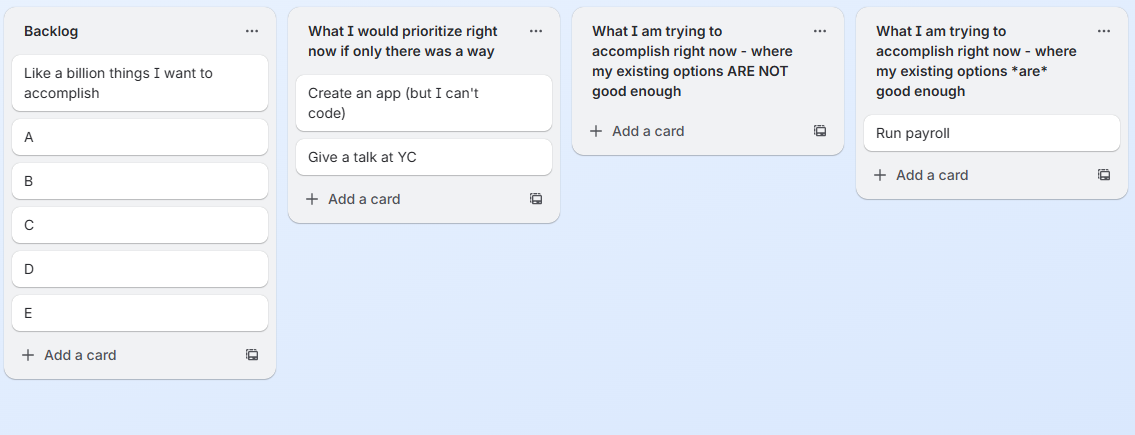
This Trello board contains two flavors of real PULL:
A buyer who is prioritizing a project right now, but their current approach is sufficiently bad that they are COPING - struggling against their current approach.
A buyer who would prioritize a project right now if they could - but their existing options are unworkable, so they are BLOCKED.
In both cases, existing options are not good enough. (Using the PULL framework, the List of Options have severe Limitations.) The only difference is that in coping PULL, the buyer is actively doing something right now with the options at their disposal - while a blocked buyer isn’t.
You can see the difference between blocked PULL and coping PULL with Uber:
Uber found “Coping PULL” - People who were previously using taxis for transportation switched from taxis to Ubers because they were coping whenever they took a taxi.
Uber also found “Blocked PULL” - Before Uber, people would simply stay home when they wanted to go out, because they didn’t want to deal with the hassle of a taxi. Market commentators who attempted to “size” Uber’s market based on the size of the taxi market didn’t realize that there was blocked PULL; turns out, the market was much bigger than just taxis.
We are, in other words, looking for people who are blocked or coping right now - they are coping and blocked independently of us existing. This is where there is “market opportunity”, where they will rip a fitting product out of our hands with little convincing. If we do not find this, we are working against a buyer’s priorities, and it feels like we are pushing them to want our product. They very rarely do - how likely is it that someone will change their Trello board because we want them to? How likely is it that this will happen repeatedly?
With both blocked PULL and coping PULL, you can really only know if it’s real by trying to sell something and seeing how potential customers react. But there is some nuance in how you find blocked PULL versus coping PULL, and each path has different risks.
Coping PULL
With Coping PULL, you can observe someone struggling against their current approaches and tools. They are prioritizing something on their Trello board, but their existing options don’t “fit” well, and as a result they are fighting against their options.
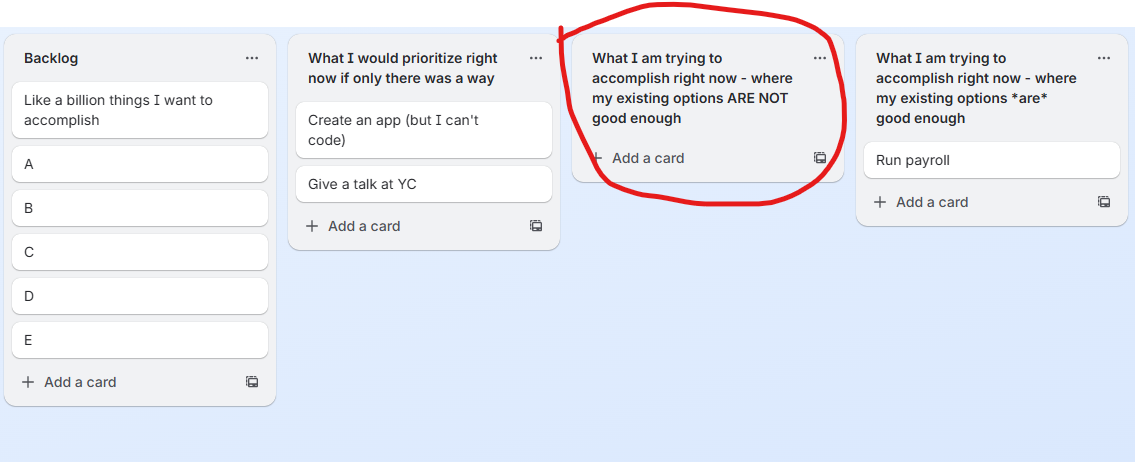
My favorite example of this is Jump - the AI notetaker for financial advisors. Before Jump, financial advisors took notes manually for their client meetings, and entered those notes manually into their CRMs. This notetaking was required for legal and compliance reasons. But financial advisors were coping as they did this, because the project on their to-do list was “spend the least amount of time manually taking notes as humanly possible.” If you watched financial advisors as they did their meeting admin, you could see them entering notes into their CRM - but more importantly, you could sense them not wanting to be doing this work. When Jump showed up, financial advisors ripped the product out of their hands because they were coping, struggling against their existing method.
Another example is Rippling - the HR & IT platform founded by Parker Conrad. Everything Rippling is doing, from payroll to employee surveys to device management, was all stuff that was done before Rippling existed. But it was admin work that was handled manually by different people across different systems - and Parker sensed that people were coping when doing this kind of admin work. And perhaps buyers were coping by needing to have multiple admins manage all these different systems and processes. Because of this, Rippling’s product was architected assuming the buyer’s project was to “automate all the tedious admin work around HR + IT”.2 This led Rippling to build a differentiated product that actually worked in the market.3
The examples so far have been where someone is coping against an existing solution they are currently using. Another variant of coping is when someone is in a decision-making process, not using anything today, yet they perceive their existing options to be really bad-fit. An example of this is a friend’s carbon compliance startup: In order to get carbon credits they can sell in carbon markets, clean energy projects need to go through a certification process. There isn’t an option not to go through the certification process. Before my friend’s startup showed up, the only way to go through the certification process was to DIY manually or work with expensive consultants. Buyers were coping hard with these options - such that when my friend’s startup showed up with a lower-cost “AI-enabled service” option, project owners pulled the product out of their hands.
If I’m being honest with myself, I often use Claude or ChatGPT as a form of coping PULL. Before AI, when trying to answer some question or solve some problem, I would think about it in my head. But that is hard and uncomfortable; I am coping while doing that. My project is really to “answer/solve this with the least amount of mental effort.” So why not shout at AI instead of thinking?
How do you find and validate Coping PULL? It is observable - so you should go watch buyers doing their jobs (or ideally, you do their jobs alongside them). Here’s an approach:
Watch for places where they are fighting against their existing supply - methods, tools, or people. (E.g., watching financial advisors grumble as they manually enter notes into their CRM)
Try to infer what their project really is based on where and how they are struggling. (E.g., “hmm, maybe they’re really trying to spend the least amount of time manually taking notes as humanly possible”)
Use sales to validate that their coping PULL is real. You want to hear, “OMG how do I get started right now”, not “Oh, that could be helpful.” The latter means they’re not coping hard enough to rip a “better” product out of your hands.
The risk of attacking “coping PULL” is, as Bob Moesta likes to say, “bitchin’ ain’t switchin.” People can complain and struggle, and tell you that your product is awesome, but not buy it. This is why you have to try to sell and observe the buyer’s energy. If it is like a dam bursting, and they rip it out of your hands, that means PULL is real.
Blocked PULL
If you observe somebody in their job or life, you won’t see the things they would prioritize if only they could.
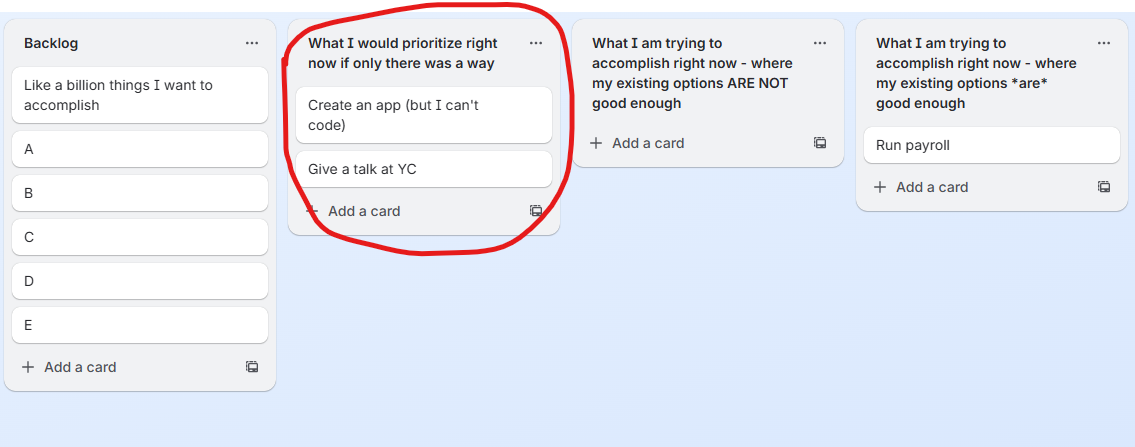
A classic example is Lovable, the vibe coding tool. Before Lovable, there were a bunch of nontechnical people who wanted to build apps and websites, but weren’t because no-code builders required too much time and skill. If you’d watched nontechnical people before Lovable existed, you wouldn’t have seen them trying to make apps. They were doing other things… but while they were doing these other things, they wanted to be making an app.
Another example is an early stage startup out of HBS that sells into independent physical therapists. The founder went in-person and shadowed physical therapists, searching for PULL. But he didn’t find anything until he got access to one physical therapist’s P&L - where he saw a very expensive line item they were paying for each month on autopay. Importantly:
He wouldn’t have seen this just by watching the physical therapists do navigate their days.
Just seeing the expensive line item didn’t mean there was PULL to reduce this cost (or to cut costs generally). It wasn’t clear that there was a project in the “would take action if only there was a way” category.
So he tested to see if there was PULL by pre-selling an idea to five independent physical therapists, who ripped the product out of his hands.
A third example: Wiz. As a CTO recently explained to me - “Before Wiz came around, I had this anxiety on the back of my mind about our Google Cloud setup, and had no good way to know if and where there might be security vulnerabilities. The second Wiz showed up, I saw the demo and immediately bought it and felt instant relief.”4
How do you find blocked PULL? This isn’t something you’ll directly observe by watching customers do their jobs and seeing where they’re struggling. But don’t take that as an excuse to go to the whiteboard and envision some random nonsense!
You can infer the categories of things they would do by observing them firsthand and seeing how they generally behave. In other words, if you see someone agonizing over their cash flow every day, you might sense that they would pull anything that helps improve their cashflow. You might then find a hidden cost to remove, or a new revenue opportunity to exploit - but these will only work if they fit blocked PULL. They won’t just work because it is “increase revenues or decrease costs.”
Cyberstarts asks buyers questions like: “what would you pay me to solve for you?” or “If I spent $100M to build something that solved something for you that you’ve been unable to solve, what would I solve?” - these kinds of questions can surface things that they aren’t doing, but wish they were!
Obviously, you still test blocked PULL by selling. And you’re still looking for the kind of “dam bursting” energy that you’re looking for when selling against coping PULL.
The risk is that it is very easy to wish-cast blocked pull - “Don’t you want to increase revenue?” - pushing something you think they should want based on what makes sense in your brain, rather than what is actually on their to-do list in the “would take action if only there was a way” category.
PS: Work with me!
I have availability in late Feb/early March for some advising. If you want my help diagnosing your sales calls, fixing your targeting and pitch so customers PULL, grab time with me here and see more detail + testimonials here!
There is a fifth category - “projects we think they should prioritize” - which isn’t on their Trello board, but founders waste their lives in pursuit of products that serve this kind of project!
This is not necessarily the case with all admin work - do not take away from this that just saying “we reduce admin work” is the path to PMF!
I also think of Microsoft’s Office Suite generally, and Teams specifically, in terms of an enterprise IT buyer’s coping PULL. This buyer is inundated with point solutions that different teams want to buy that all need to be vetted, integrated, and managed. This buyer’s PULL might be something like “equip our teams with the tools they need with the fewest number of vendors and the lowest possible cost.” So when faced with Slack or Zoom versus Teams, they see equivalent features, but Microsoft means no new vendors and lower costs. Does it matter that Slack and Zoom are better products, or that Teams crashes everyone’s computer every 4 hours? Not one bit! (I exaggerate slightly, but you get the point - what matters is what the buyer’s PULL actually is, not what it should be!)
Here’s a list of other examples of blocked PULL:
Microsoft’s first product - BASIC interpreter for the Altair, then language interpreters for other minicomputers
Vanta - SOC 2 compliance was too expensive, confusing, and time consuming for startups prior to Vanta
SpaceX - by reducing the cost to send stuff to space, they are unblocking tons of PULL
Rent the Runway - you would not have seen people shopping for dresses for every event because that was too expensive.
In general, Blocked PULL explains “new market disruption” from Clay Christensen’s disruptive innovation framework.