
Customer language 101
A translation guide
👋 Hey there, I’m Rob. Each week I write a newsletter and record a companion podcast (Spotify, YouTube). Also:
My book is coming out July 7. Pre-order it HERE.
If you’re an early-stage founder doing all the right things, but it’s not quite working & it feels like you’re hitting your head against a wall - I run a founder bootcamp and advise startups for this exact stage. Learn more and reach out HERE.
If your messaging isn’t landing in sales calls, and want me to tear your calls down and help you fix your pitch/messaging/demo - I also do that! Learn more and reach out HERE.
Whenever a customer talks, you get a messy bundle of words that I’ve previously called a “demand hairball”:
They usually say about 47 different things in this monologue. They talk about their current state, their problems, their pain points, their cousin-in-law, and maybe a project they could use your help with.
I now think of this monologue as “them hacking up a demand hairball”.
I called this a demand hairball, as if what the customer says is, by default, in demand language. I was wrong.
Customers do not speak demand language. They speak customer language. Customer language spans demand, supply, and random nonsense. The scary part about customer language is that it sounds like our language. Imagine a foreign language that uses all the same words and grammar that we use, but the meanings of the words and sentences are wildly different (sometimes). That’s customer language!
For example:
In customer language: “Wow, this is awesome - exactly what our industry needs!”
This translates to: “I don’t need this right now, and may not ever need it!”
Customer language, it turns out, is behind much of our pain as founders. We think we understand it, and we only get a hint that we might not when customers don’t buy or seemingly happy customers churn. Or in a sales call, we hear what sounds like enthusiasm… and then get ghosted. Ever wonder why the default state of a startup is “built something nobody wants”, despite literally everybody setting out to “build something people want?”
So then, how do we translate from customer language to our language?
Let’s take a potential customer’s answer to the question, “Why did you take the call?”
Yes, so, we’ve been struggling with Salesforce ever since I’ve been here - which is, wow, going on like five years now. Crazy how time flies! Anyway we’re obviously a mission-driven nonprofit, and Salesforce doesn’t feel like it’s built for us and what we need to do, managing volunteers and whatnot. I know other people who are in sales roles obviously, and in tech or whatever, and Salesforce seems like a great fit for them! But for us, we’ve had to get a bunch of consultants to come in and try to clean it up, and we’ve had multiple rounds of that in my time here. But it’s just not reflecting our work to funders, and now that we’re fundraising and the current environment is what it is, we need to fix that. So basically, my boss, our CEO, asked me to look into alternatives to Salesforce sometime in the last year or two. I haven’t yet talked to anyone yet though.
This is an example from my upcoming book, and it is actually a lot less hairball-y than most of the monologues I see. When you translate it, you see that some of the content in the monologue is useful, some of it is useless, and some of it is counterproductive.
Before I explain how to translate customer language into our language - I want you to sit with that quote and ask yourself: What does this person want? What, if anything, will they buy?
My translation guide
The best way I’ve found to understand customer language (and, by extension, startups) is by separating demand from supply.
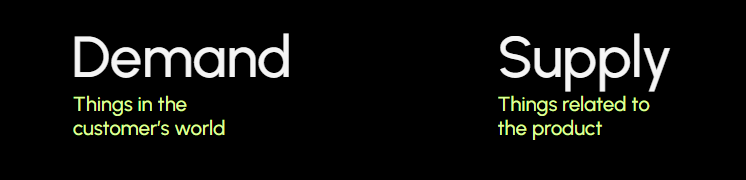
Demand is what’s happening in the potential customer’s world, what they’re trying to do and achieve. Supply is about products. Demand is not “desire for a product”.
Most of what this potential customer says is on the supply side:
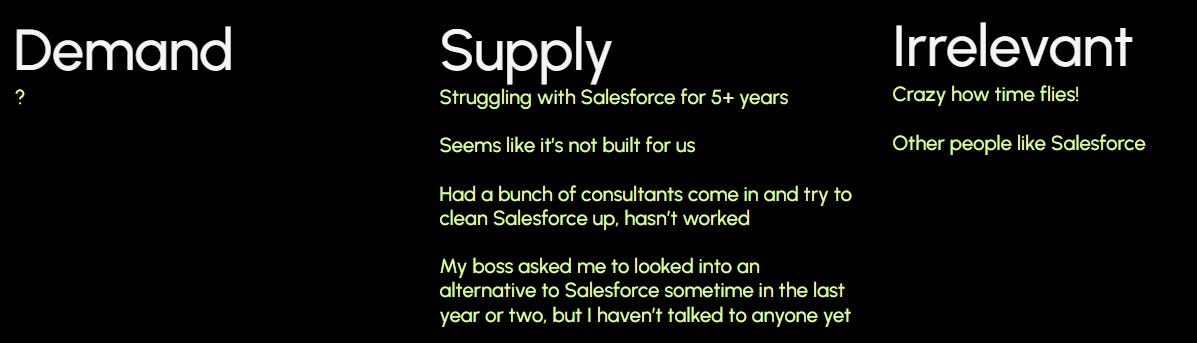
We get a lot of complaints about Salesforce. But if someone can struggle with Salesforce for five years, they can struggle for fifty. As Bob Moesta says, “bitchin’ ain’t switchin’!” If they haven’t talked to anyone even after the CEO asked them to look into an alternative to Salesforce over a year ago, clearly it’s not that important, right?
But. What is going on in the customer’s world - what is happening on the demand side?
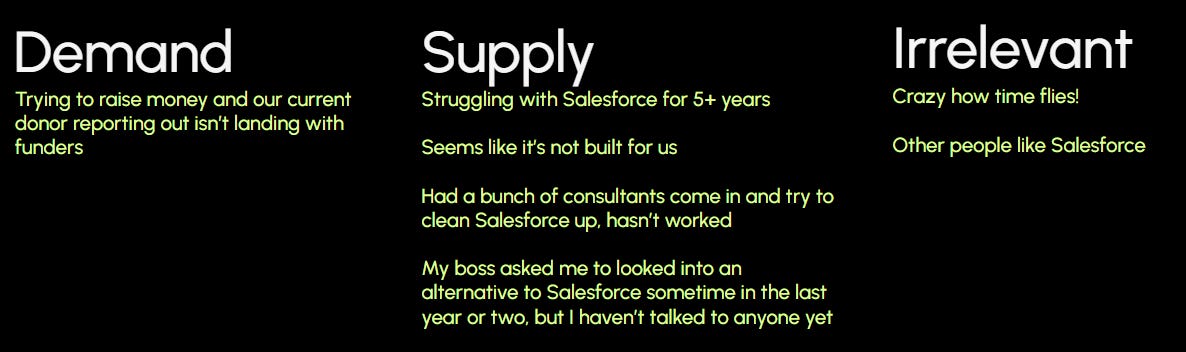
Ah - there it is. They are trying to raise money… but their current reporting isn’t landing with funders.
Now we have a rough sense of what’s going on. We have started to untangle the hairball, but we don’t yet know exactly what this potential customer wants. Here’s where the PULL framework comes in:
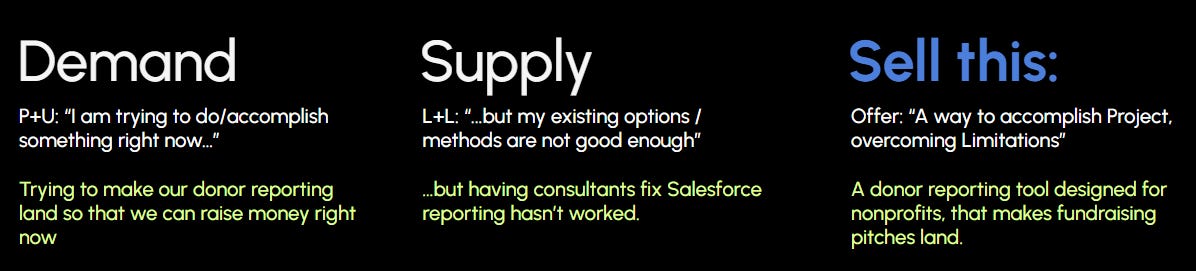
With the PULL framework, we can finally translate from “what they say in customer language” to “what they want in our language.”
Now, of course, you’re going to want to double-click into some of the words here - why exactly hasn’t their existing reporting landed? What does it mean when they say that consultants haven’t worked?
But even without double-clicking, you can see that while it sounds like they’re looking to rip and replace Salesforce based on the words in the monologue, the translation suggests they might not actually want to replace Salesforce - they just want better reporting!
If you take their monologue at face value, you might wind up building a full alternative CRM when you don’t necessarily need one. And then just imagine the sales pitch and sales cycle for trying to sell an alternative CRM to Salesforce to this potential customer. It’s going to be a nightmare! They’re not going to buy because they just want better reporting for donors - and ripping out Salesforce is a HUGE project.
Now that we have a translation guide for customer language. But we need one last step - as we interpret the things they say using this framework, what should we trust?
On the demand side:
Trust that they kinda know what they’re trying to do/accomplish, but often need help articulating it concretely. They often use vague language - like “our donor reporting isn’t landing”
On the supply side:
Trust that they can complain about existing tools/methods they don’t really like - but don’t conflate “disliking supply” with “having demand!”
Don’t trust when they say “supply they want” - because that will lead you astray! (E.g., “Looking into an alternative to Salesforce” will literally steer you into the iceberg. For another example, see this post.)
Find this useful? Share it with another founder or in a founder group!
Got a topic you’d like me to cover? Email rob@reframeb2b.com!