
Inverting the idea stage
Cyberstarts and building demand-first
Pre-order my book, The Power of PULL - it’s coming out July 7!
This week’s podcast:
If you want to build a company that grows very fast, you should know about the Israeli VC fund, Cyberstarts. They are focused exclusively on cybersecurity with a consolidated but powerful portfolio that includes:
Wiz (acquired by Google for $32B)
Avalor (acquired by Zscaler for $350M)
Axis (acquired by HPE for $500M)
Bionic (acquired by CrowdStrike for $350M)
Noname (acquired by Akamai for $450M)
Their first fund was $50M and wound up seeding companies that make up HALF the market cap of private cybersecurity companies. (If you want more detail on Cyberstarts, there’s a great podcast HERE.) You get the point - they fund companies that win.
This kind of success probably doesn’t happen by accident. Cyberstarts has a playbook, called Sunrise, which invests in founders before they have an idea, THEN helps them find ideas and product-market fit.
This playbook is an extreme version of what I’ve been writing about: Find demand. Sell then build. Work directly with buyers.
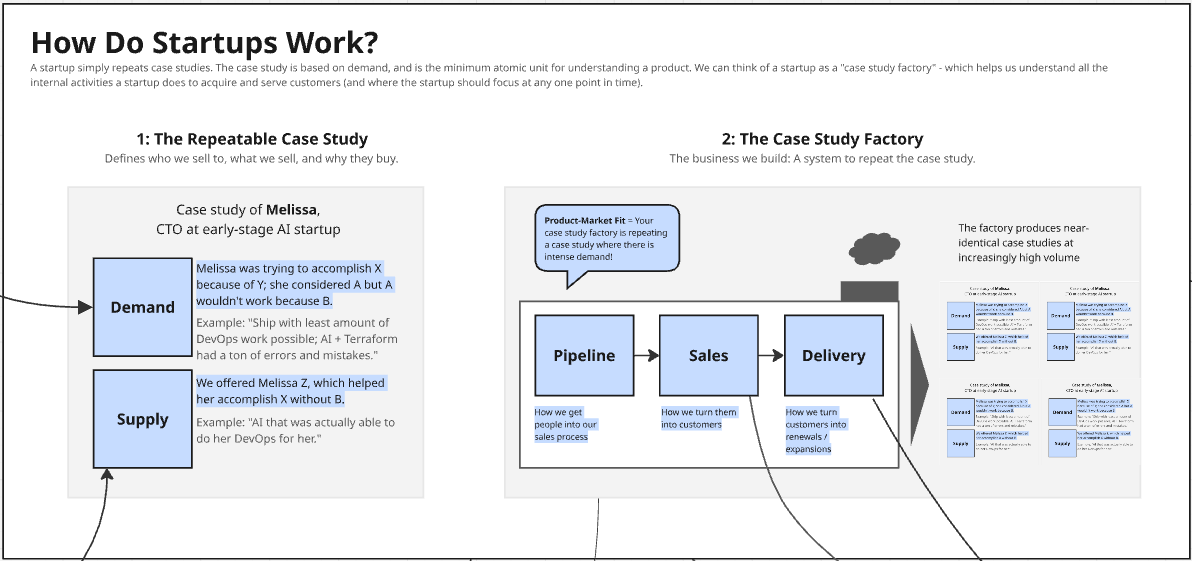
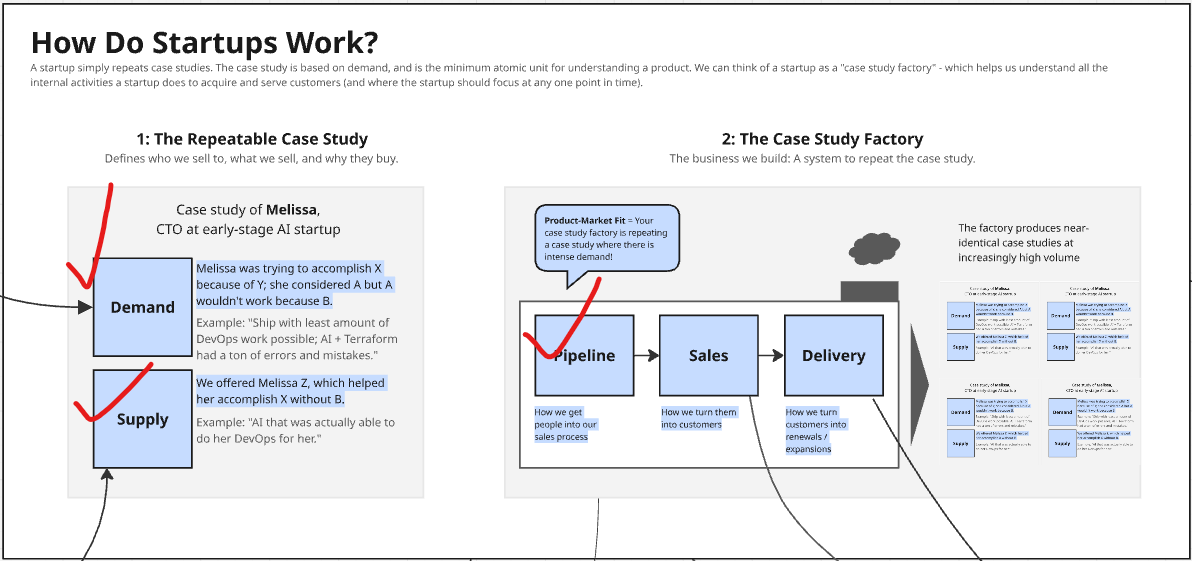
If you look at my Physics of Startups Miro, the Sunrise playbook is a super-fast way to construct your case study factory with a very low risk of failure. It’s no wonder their hit rate is so high.
Here’s the Physics of Startups:
Cyberstarts’ approach speed-runs most of it:
Whether you are just starting out, navigating pivot hell, or trying to build your next product, it’s worth understanding the Sunrise playbook. You can definitely run it yourself.
Here’s the graphic, from their website:
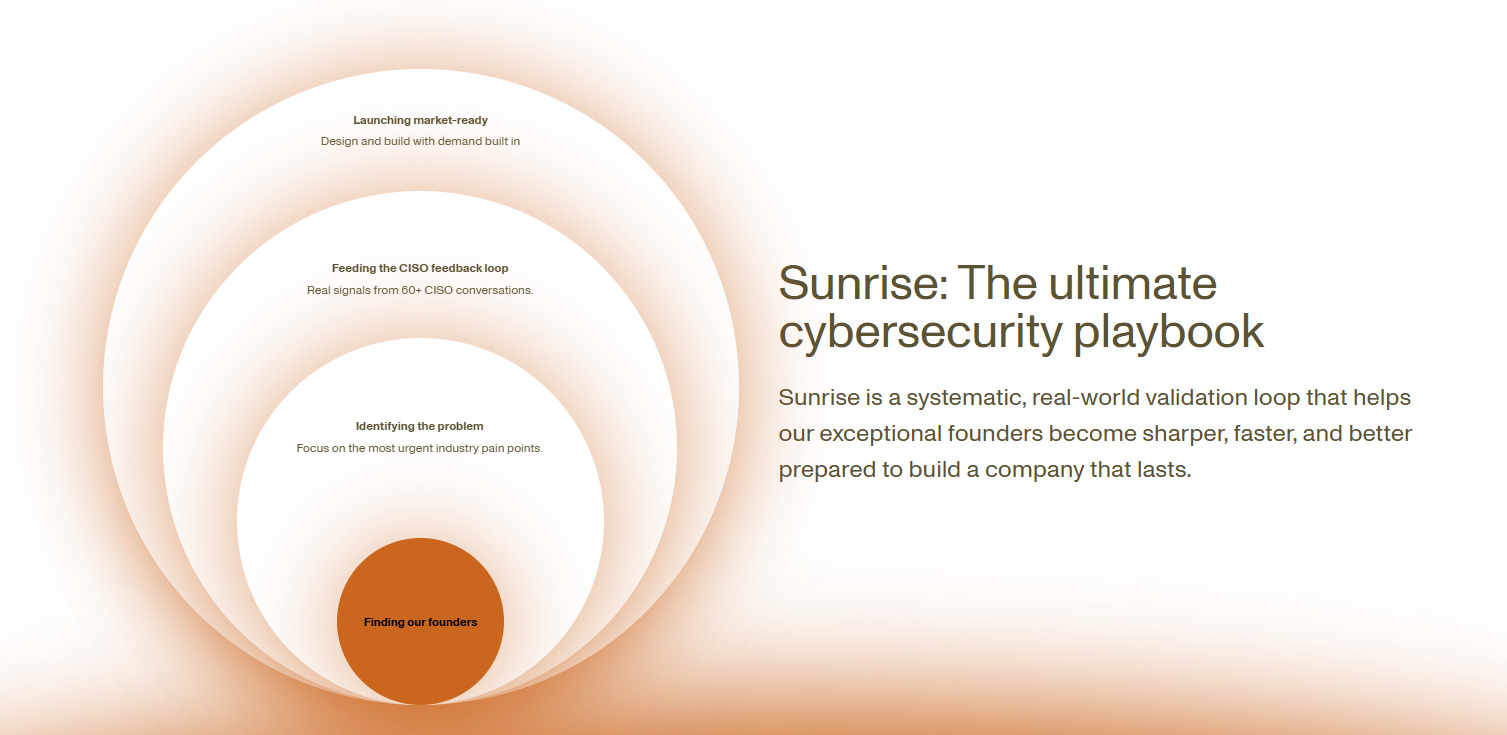
Let me walk you through the Sunrise playbook as I understand it.
Part 1: Find demand.
(AKA: Avoid building something people don’t want.)
The idea stage of startups is a trap. It is fundamentally unnavigable. As Commoncog writes: The idea maze is a useless idea.
In this stage, there are infinite product ideas that could work - that could be something that people want. Yet there are finite things that will turn into real businesses - and even fewer that will turn into businesses that take off.
When there are very few things that will work, and infinite things that could work, and it’s basically impossible to know ex-ante what will work or fail… you will fail by default.
This is a long way of saying: The math is always against you in the idea stage. So? You should just avoid the idea stage entirely.
The Sunrise playbook does exactly that - it simply avoids the traditional approach to the idea stage, where a founder has a notebook of mostly-crazy product ideas that all could theoretically work. Instead, they approach the idea stage backwards.
Founders who follow Sunrise meet with buyers - Chief Information Security Officers - before they consider product ideas. In these meetings, they figure out what demand CISOs have that they would be willing to pay to solve.
In the Sunrise playbook, they describe this as finding “problems” and “urgent pain points”. Those aren’t the words I’d use. Instead, I’d say they are finding PULL:
What is a buyer trying to prioritize right now, where their existing solutions aren’t good enough?
This is the essence of the PULL framework. It is not about “what product they want” - there is still no product idea yet. It is about what they are blocked from accomplishing.
How they get CISOs to talk to their founders? My understanding is that Cyberstarts has a large and growing network of CISOs who commit to meet with their founders. Founders have dozens of deep conversations with CISOs in weeks - they don’t have to beg busy CISOs to meet them.
One of the fastest-growing startups I’ve ever seen did something similar to this. They had a rough idea of the space they wanted to sell into - a certain kind of medical clinic - and recruited an advisor + investor who was super well connected with CEOs of large groups of medical clinics. They got intros, and instead of pitching their idea, they figured out what these CEOs’ PULL was, offered supply that fit their PULL, and secured millions in contracts in months - while they furiously built their product.
Part 2: Nail supply and get early case studies.
Once you know what demand is, you now have the chance to figure out the supply side - the product idea. At this point, you have a rough sense of the “shape” supply must fit into:
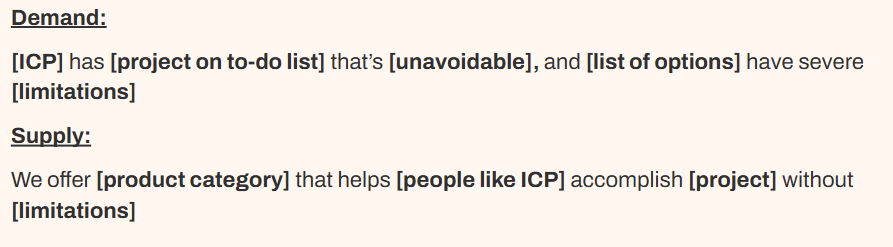
In Cyberstarts’ Sunrise playbook, founders know exactly what buyers are prioritizing, but are blocked from accomplishing. They go back to these CISOs, show them a sketch of the solution, and sign a few up as early customers. Early customer commitments are validation that demand is real, and they can start building and delivering.
Once the startup has built enough to nail their repeatable case study across a few referenceable customers, they launch publicly and drop a brick on the gas pedal. The only constraint on their ability to scale is demand - specifically, which CISOs are prioritizing this right now and blocked?
Sunrise breaks the traditional physics of startups
Instead of spending a ton of time navigating ideas that all seem compelling but are highly unlikely to work, the Sunrise playbook skips the idea stage and starts with demand.
Instead of spending a ton of time trying to get buyers to meet with them with extremely low conversion rates, they have a network of buyers they can tap into and meet with in rapid succession.
Instead of trying to convince buyers that they should want something and fighting against buyers’ priorities, they design around buyers’ top PULL right now - and sales cycles are extremely fast, even in enterprise, as a result. Large deals get closed in weeks if it’s a CXO’s top thing. Deal velocity obeys a power law - the number one priority gets closed in weeks, anything else takes 12-18 months.
Velocity begets velocity. Because deals move fast, the product gets implemented fast, the team gets feedback fast, and the product gets better fast. If needed, the business attracts capital because of the velocity. Cyberstarts’ startups often raise $100M+ in the first few years as they scale to attack the product and market opportunity.
Counterintuitively, I think it is actually easier to build this kind of company than it is to build a company where you are focused on someone lower in the organization’s #2 priority with decent enough alternatives - the latter might seem safer, but it is often just a painful slog. Might as well take growing pains than not-growing pains.
Will this work for you?
There are, of course, many examples of successful startups that aren’t built this way. Zapier, for example, started with just an idea - a text that said something like, “hey what about an API for APIs lol”.
And I don’t always recommend building an advisory network - I have seen it work well, and I have also seen it being a total distraction. In my experience, this tactic really works if (1) you are selling $50k+ ACV deals and (2) the advisors are C-level.
But in general, I strongly recommend inverting the idea stage - focusing on demand before you focus on supply - because life is too short to build something people don’t want right now. This approach seems to be the lowest-risk way to build what people actually want, and a way to mostly avoid the infinite pre-PMF wilderness.
PS: PMF Camp starts Monday!
It’s basically full, so if you’re desperate to join just email rc@reframeb2b.com. More detail HERE.
You can also get me as an advisor or to review a few sales calls - I have some availability later this month / early March!
Yeah I mean, the biggest question is how do you find demand