
THE B2B STANDARD (v1)
Opinionated product-market fit metrics for sales-led B2B startups
Hi! I’m Rob Snyder, founder & author of The Power of Pull - now available worldwide!
Want some very helpful pre-PMF sales skills? I’m open-sourcing:
My Sales Call Review Claude Skill: Paste a transcript (or five), get my feedback. Is there real pull? What is it? What should you do differently?
My Weekly Startup Review Claude Skill: Set a weekly ritual to see how you’re performing vs. these standards, so you don’t waste precious weeks.
Give them a try, let me know what you think!
I meet two kinds of early-stage B2B startups:
#1: The promising startup that has the chance to become an outlier. They don’t want to miss their chance, but they aren’t sure whether they’re doing all the right things.
#2: The startup that doesn’t realize they’re dying. It seems like they are on the path to hypergrowth, yet they very much aren’t.
Most startups are both, simultaneously: I talked to a founder who, in a single week, realized that, despite having real revenue and Fortune 500 customers, his pipeline was mostly fake and his company was in deep danger. If you think this is a rare thing that can’t possibly happen to you: He did too.
Me: “What could I have told you six months ago that might have caused you to realize this sooner, when you could have course-corrected?”
Him: “I wish I’d had some way to know what ‘good’ looks like. What should my expectation be? What does good traction look like? And, importantly - I want “good” defined in a way that I can’t weasel out of, so I can’t convince myself that I’m doing well when I’m actually not.”
So, to honor his request: Here is the standard - what “good” looks like - for a sales-led B2B startup.
The standard applies if you’re selling enterprise or SMB, AI or SaaS. It applies before you have hired in sales and after you’ve hired in sales. It applies from the moment you have an idea - not “when the product is ready.” (If you don’t have an idea - read THIS.)
If you don’t think the standard applies to you, please think again.
The standard has six components:
Repeatable Case Study
Pipeline
Pull
Close rate
Cycle time
Success rate
Hitting only five means you have not met the standard. And hitting this standard is the starting line, not the finish line.
The standard is tough love. We need tough love; I know exactly what it feels like the moment you realize you’ve missed your big opportunity and that you could have done something differently six months ago if only you’d known. I don’t want you to have that feeling ever.
Startups want to grow fast. Not growing fast means something is wrong. If you aren’t hitting the standard, something is wrong. Hitting the standard is the ONLY priority in the pre-PMF stage.
1 - Repeatable Case Study
A startup is just a case study factory, where we produce near-clones of a single case study. The repeatable case study is the foundation for go-to-market, product, and scale.
You must have ONE repeatable case study. This case study articulates exactly who you sell to and exactly how you describe your product. If you don’t know these things with extreme clarity, you don’t have a repeatable case study, and that means you don’t have repeatability and aren’t ready to systematize or scale sales.
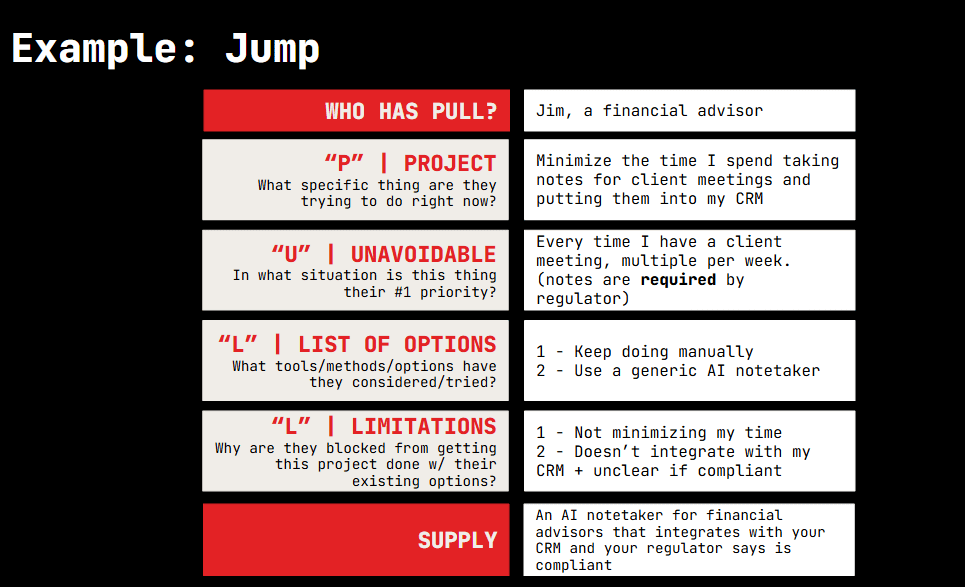
Importantly: Your ONE case study must be written in a way where it would be weird if the person in the case study did anything OTHER than buy your product right now.
If they could just DIY it with Claude Code, it would be weird if they bought from you. If they could delay buying your product, it would be weird if they bought from you. If they could just do nothing, it would be weird if they bought from you.
Below is the example of a repeatable case study using the PULL framework. Fill out your own, then ask: Would it be weird if this person did anything other than buy from us right now?
2 - Pipeline
Most startups are bottlenecked on pipeline - or “meeting enough new customers.” Few treat it as their bottleneck.
The standard varies based on the size of your initial contract:
Big contracts ($100k+): 3 first meetings per week (per person selling)
Moderate contracts ($25k-99k): 10 first meetings per week (per person selling)
Small contracts (sub-$25k): 15 first meetings per week (per person selling)
As an example: Before Tabs even had a product, each cofounder was scheduling 3-4 meetings per day. (See their story HERE.)
3 - Pull
The standard is that 60% of first meetings have “pull”, defined below, as graded by my sales call review skill. (HERE)
When customers have PULL, they try to buy. “Pulling” = “trying to buy.” The potential customer initiates a “trying-to-buy”-shaped action:
If you’re selling to a startup or small business, the person you’re talking to will try to buy on the call - they’ll ask for the Stripe link and schedule an onboarding call, for example.
If you’re selling into a bigger company, they almost certainly won’t buy right away, but they will do something close to it - for example, saying, “Ok, I need this, and here’s what needs to happen so I can bring this into my organization.” They will then walk you through who needs to approve and they’ll initiate the deal’s next steps.
From: Are they pulling?
4 - Close Rate
Of your sales meetings where there is “pull”, the standard is a 50% close rate.
(If this sounds unattainable, I have seen startups with a 75%+ close rate from meeting 1 - a metric that doesn’t exclude people who don’t have PULL! At some point, you may deliberately reduce your close rate e.g., by ‘optimizing’ pricing, but that’s a future thing.)
5 - Cycle Time
The standard varies based on initial contract size. This is from “meeting with PULL” to signed contract.
Large contracts ($100k+): 90 days
Moderate contracts ($25k-99k): 30 days
Small contracts (sub-$25k): 14 days
I could include caveats here for pilots, trials, land-and-expand motions, long legal reviews, etc. But that would make the standard something you can wiggle out of. Also, hitting fast growth often means creatively designing these things OUT of your sales process.
6 - Success Rate
When a customer buys from you, they are guaranteed to churn, until X happens, in which case it would be weird if they churned.
X is your “leading indicator of retention.” Most startups don’t know what X is, or worse, we think X is “usage” or “ROI” or “satisfaction/NPS”, when it is almost never these things. I see far too many 12-month contracts where, in month 11, the founder gets blindsided.
The standard: 95% of new customers hit whatever X is within 1 month of purchase.
1 month? Can’t implementation take a long time, Rob? Yes, but long implementations should be treated as design challenges rather than as immutable features of reality. Get to X within 1 month!
How to attack the standard
This is the standard. What are you going to do about it?
My suggestion: Review your performance against the standard in a weekly ritual where you stare reality in the face, and ask, “what do I need to change next week?” You can use my Claude skill to do this - see HERE.
Hitting the standard will probably be the most difficult thing to do in your career, and will probably take quite a while. There are cheat codes - finding intense pull, or getting someone on your cap table who can solve pipeline by foie grassing you with customer intros, or selling to the kind of customer who brings in other customers - but even with a cheat code, hitting the standard is brutally difficult, takes all your time and energy, and requires a ton of iteration. You’ll take steps forward and steps backward. Such is the game.
You have the standard. You know what good looks like. Now go make it happen. I believe in you.
(PS: If you have feedback on the standard, LMK! It is a v1!)
Psst, if you’ve made it here: I will be giving five early-stage B2B founders access to “AI Rob” for one month for $50. AI Rob may eventually become a paid skill that helps startups do pre-PMF sales - it drafts your case study, drafts and iterates your call scripts, drafts your outreach, does all your call prep and follow-up emails… and basically everything else. I use AI Rob daily myself! If selected, you’ll also join a Slack channel with me. Email me if you’d like to be one of the five: rob@reframeb2b.com.
Thank you, this is very useful! Anything similar for B2C?