
Aero mode
Weird not to buy + weird not to meet with you
When you start out, you usually have fourteen different potential ideal customer profiles, forty different value props, and a trillion different go-to-market ideas. Most make sense and could work. And you have to scrap basically all of them in order to succeed.
The goal is to find one thing that repeatedly works and scales via one GTM approach. This is how you’ll get to $1M-$10M+ ARR without raising a ton of money or building a massive team.
An analogy:
You start the race in party bike mode…

…but to survive and scale, you need to get to “aero” mode:

The point is to maximize pace and minimize wasted effort. But everything we do adds wind resistance:
When we have to convince customers to buy, use, and renew, it’s like dragging people behind our bike. Not a way to get anywhere fast.
Adding ICPs, GTM approaches, and value props is like adding seats and gadgets that slow us down.
Two questions to get to aero mode:
Who has PULL? Who would be weird NOT to buy?
What’s ONE pipeline approach that works? How do you get some subset of the people with PULL to be weird NOT to meet with you?
PULL = weird not to buy
I feel like I constantly understate the importance of PULL and the structural logic behind who would be “weird not to buy”. PULL answers 90%+ of your startup’s questions - from “who do we sell to” to “what do we build” to “how do we retain customers” - in an elegant way that requires the least amount of wasted effort from you!
Yes, many people COULD buy your product - but only people with PULL would be weird NOT to:
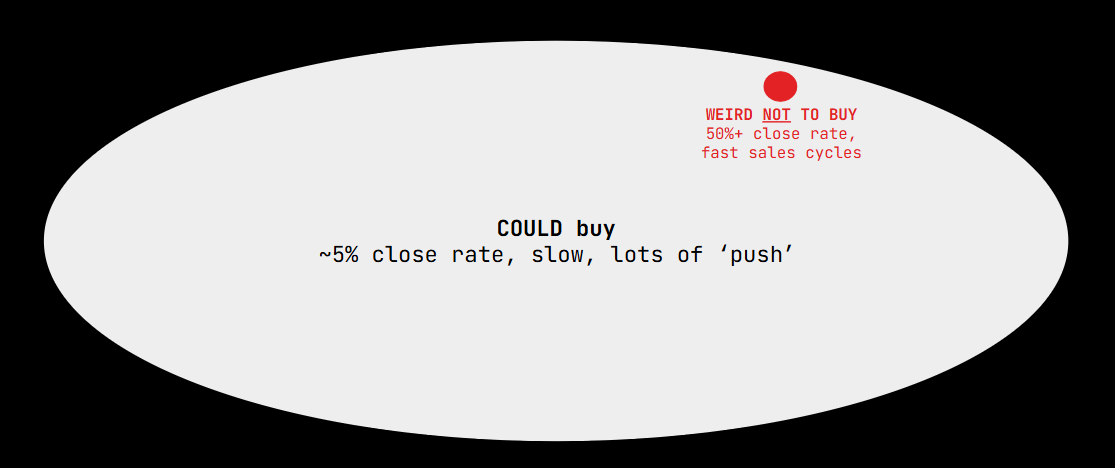
An example: I caught up with a friend who’s running an AI SEO company based in Asia. Many businesses should want AI search services. Who wouldn’t want to grow revenue and show up in this new channel?
He started by selling to customers of all shapes and sizes: Tech startups, mortgage brokerages, manufacturers, and healthcare services companies. Some of their customers are startups that still think “stealth mode” is a thing; others are decades-old multinationals.
But the cracks were showing in his “party bike” approach (despite his startup doubling revenue month-on-month): Some deals were closing in one call while others were dragging along for months. It wasn’t clear exactly what customers wanted - they were getting all sorts of different feedback and feature requests. Plus there was some churn, and people were churning for different reasons - many of which didn’t seem like they were within his startup’s control.
When many people can (and do!) buy and renew, it’s hard to figure out whether to narrow down, and if so, how. So many different approaches to their ICP would make sense and might even kinda work.
To get into aero mode, they need to accept the Iron Law of PULL:
Not everybody who should want it buys; not everybody who buys is sold; not everybody who benefits renews. Many customers who DO buy could have NOT bought, and many customers who DO renew could have NOT renewed.
(Read that again.)
This leads us to the simple but awfully difficult question: Who would be weird NOT to buy and renew?
In this startup’s case, is it:
Somebody who wants to grow?
Somebody who “gets” that AI search is the future?
Somebody with a marketing team?
A new startup that’s AI-native?
No - all of these people could buy and renew, but it wouldn’t be weird if they didn’t buy and renew!
Let’s dig deeper into a few examples, because I still see so few people actually understanding this:
People believe AI search is the future won’t have a coherent theory of success, and therefore will probably just choose the coolest option and churn the second it’s no longer the cool thing to do or doesn’t lead to them instantly adding $10M ARR like the viral X post said it would. Or they won’t buy at all, because they don’t have to buy.
People who have failed at SEO might not find success in AI search either, perhaps because people probably aren’t searching for their kind of product! For this kind of buyer, the startup would have to figure out how to make SEO work AND then make it work in AI search. (And this company probably has other non-search methods working for GTM… so they are probably OK not buying!)
People who have never tried SEO probably have unrealistic expectations from search, like expecting leads overnight. You either need to “educate” them (AKA: convince them they shouldn’t want what they want) OR expect high churn. Both are wasted effort when there are people who don’t need education/convincing out there, who will pay more and renew without your heroics.
Said differently: Anyone for whom it is OK if they don’t buy and succeed probably won’t do either. You’ll misinterpret the signals from these people as reason to build more features you don’t actually need, add urgency to your sales process, reduce pricing to be equally inoffensive to everybody, etc. AKA: all these paths lead down “party bike” mode. Which is OK, you can get places on a party bike. You just won’t get there fast.
SO WHO HAS PULL, ROB?
The person who’d be weird NOT to buy and renew has relied on SEO and succeeded with it, but is now seeing SEO results going in the wrong direction because of AI search, and needs to replace that traffic!1 Think of the structural logic here:
Relied on SEO (means SEO has worked and must work, not just “would be nice if it worked”)
SEO results are going in the wrong direction (means something must replace SEO traffic, not just “would be nice to have more traffic”)
A person in this situation buys, almost always in one call, with zero convincing. This person has a very specific definition of success that is repeatable and attainable - “Replicate what worked in SEO, but in AI search.” Which leads to a very clear product direction, onboarding process, pricing model, and basically everything else about the business.
PIPELINE = Weird not to meet with you
If you make it weird for people with PULL NOT to meet with you: Congrats! You win!
The question now becomes: Which tactic (or set of tactics) makes it weird for someone in this PULL state NOT to meet with me?
PULL tells us the exact situation we need to own in order to make this happen. In my friend’s case, it’s when a marketing leader is seeing their search traffic going down. Imagine if they were able to put an advertisement right next to the marketer’s graph of search traffic going down month-on-month:
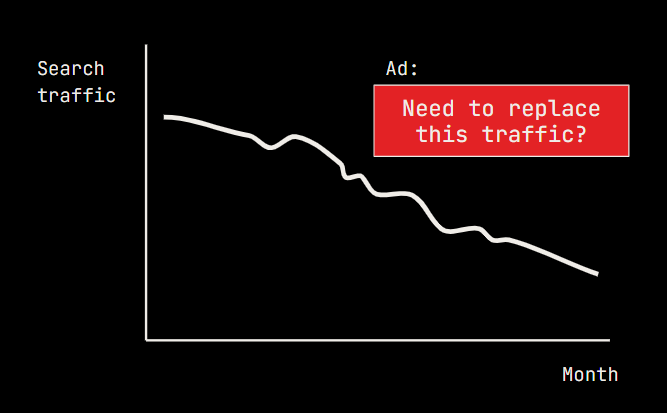
If they could do this, they wouldn’t need to do much else in order to grow fast! This is what I call a toll booth, a way to “own” the situation where someone has PULL. The way to figure this out is by zooming in on the people who would be weird not to buy:
Then you explore different tactics, and asking: “Which would enable me to own the situation in which they are weird not to buy?” This is how I visualized it in my case:
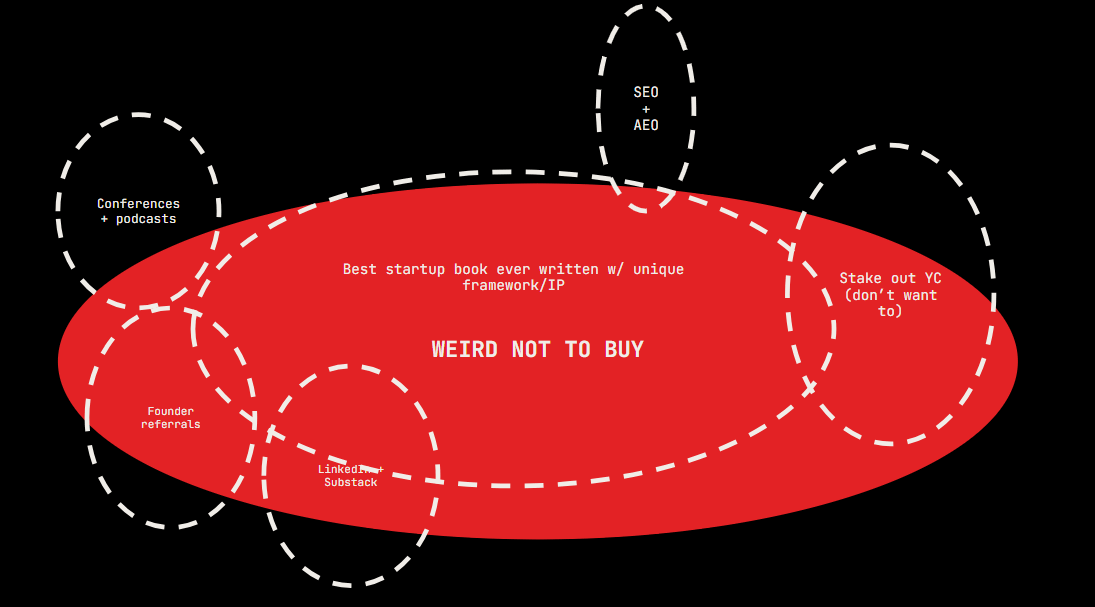
Sometimes the best we can do is a bunch of cold-calling to a decently targeted list. Usually we can do much better than that, at least to get to our first $1-$10M+.
SO WHAT?
The hardest part of getting into aero mode is saying “no” to:
Good customer segments
Solid GTM tactics
Cool features
A ton of good ideas
Immediate addressable market
Feeling cool about doing a bunch of things and being “super busy”
A bunch of things that could work
And you put your head down and pedal hard.
The startup has niched down even further to a specific vertical that is almost always in this PULL situation - but I won’t give away the whole farm.
Shame this post has only 4 likes. I loved that you used specific example of an AI SEO company. "Who would be weird NOT to buy" is such a killer question which avoids asking many other questions. It narrows down focus so much!
This was a very interesting approach to how to niche down your product or service. The pull thingy and the question you mentioned are both things I will try for sure.