
Behind a $300M exit
An interview with Palash Soni, cofounder of Goldcast
👋 Hey there, I’m Rob. Each week I write a newsletter and record a companion podcast (Spotify, YouTube) about the “physics” of fast-growing startups. What you need to know:
My book is coming out July 7. Pre-order it HERE.
My next ‘physics of sales’ bootcamp (helps smart B2B founders figure out all the variables of sales & traction) starts May 4, and is already ~40% full. Learn more and reach out HERE.
I also have availability for advising a few startups between now and book release. I can get very involved, reviewing your sales calls, fixing your sales process + outbound, etc. Learn more and grab time with me to discuss HERE.
This week, I interviewed my friend Palash Soni, co-founder of Goldcast. Goldcast is a video content platform used by B2B marketing teams, and was acquired by Cvent - an event-management software company - for a reported $300M in late 2025.
(For some reason, that Gore Vidal quote seems to fit here: “Whenever a friend succeeds, a little something in me dies.”1)
I recommend listening to the podcast to hear about the full journey, especially the mechanics of the acquisition. Here are three of my main takeaways from Palash:
When others are incinerating cash, you can still win.
Demand is subtle.
Unfolding can be painful.
1 - Win despite your (cash-incinerating) competition
Goldcast was founded in 2020. Not sure if you’re a history buff, but that was right around the time of COVID. A virtual events platform during COVID, in theory, sounds like a no-brainer investor pitch. But having three Harvard MBA cofounders has never been a recipe for easy VC fundraising. And for Goldcast, it was even worse:
“I think four startups had all already raised $10 million in our category. When we started raising our pre-seed round, we got a ton of pushback about competition.”
You might have heard of the “kingmaker” idea in venture - that, by pouring a ton of money into a company, that company can suck up all the oxygen in a category, while everyone else starves. That was happening in the virtual events category - Hopin, for example, wound up raising a billion dollars. Three other startups raised over $100M.
Goldcast was on the other side of this kingmaking strategy. For them, every fundraise was brutal.
Yet today, Goldcast is basically the only success story in the category. (Hopin, for example, seems to have sold for something like $15M after raising $1B.)
How did Goldcast win?
“I think capital indigestion causes lots of problems. If you have raised a lot of money, you can only attack the very obvious and big markets. And it’s nontrivial to change courses. If you’ve raised $100M and you’re not doubling every year, then what are you doing? This creates opportunities for more agile, smaller players.”
Everybody else built broad virtual events platforms and targeted anyone running an event, focusing on the biggest events. Many of these events wound up going back in-person post-COVID.
Goldcast, on the other hand, focused narrowly on B2B marketers. B2B marketers were running webinars pre-COVID and, Goldcast believed, would still be running webinars post-COVID. Their contracts were much smaller than their competitors’ splashy contracts with big event producers, but the Goldcast team felt that (1) B2B marketers’ event needs were unique enough that a differentiated product could be built for them, (2) revenue would be durable and recur post-COVID, and, most importantly, (3) they didn’t have the money to directly take on the broader events market and didn’t have any better ideas, so why not go all-in on B2B marketing?
Still, it was a really difficult choice:
“We were questioning ourselves all the time… but I think because things were working, we were getting referenceable customers, we were winning a decent number of deals against these better-funded competitors in our space because that flywheel had started working. Our competitors had big customers like Mobile World Congress; they couldn’t focus on a company like Drift that was going to pay you $10k-$50k per year.”
Goldcast’s approach - focusing, building repeatability, nailing the fundamentals - is SO BORING in comparison to the YOLO-BLITZSCALE-TO-THE-MOON approach. But I have seen time and again that shockingly few of the latter stories have happy endings. We don’t see this, because while these companies are very loud on the way up, they die quiet, whimpering deaths. Critically, those that do succeed while raising a ton of money nail the fundamentals (and usually nail them before raising huge sums) - who are we serving? how do we scale with thoughtful unit economics and drive repeatability and retention? how do we do the basics super well? (e.g., Stripe, Ramp)
2 - Demand is subtle
So, Goldcast decided to focus on B2B marketers. What exactly did B2B marketers need?
B2B marketers had been doing webinars. They had only seen WebEx in the past. So they didn’t know what to ask for. When we showed them our prototype, they were asking for integrations and stuff like that. So we focused too much on the integration and analytics parts.
When we built the product, a lot of people started giving feedback, like “Hey, I want this to look like my product and my brand.” They wanted the product to look great because that’s their first impression. We always thought that was superficial; why would anyone care about that? But marketers do care about that. And so that was a lot of learning for me.
This quote, I think, nails the subtlety of demand.
B2B marketers were running webinars and virtual events. They had used tools like WebEx and Zoom up until that point, and they were coping with those tools. They didn’t quite like them, and there were a lot of reasons they didn’t like them, but it wasn’t clear what, if anything, would cause them to switch tools.
B2B marketers almost certainly complained about integrations and analytics in interviews. And so Goldcast focused on integrations and analytics, which felt like a very clear differentiation vector with a serious value prop. I am certain the Goldcast founders felt very comfortable with the hard ROI story they could pitch. All sounds great… but it didn’t sell.
What really mattered, it turned out, was making the product look great for event attendees - the ability to customize the front-end to your company’s brand. This fluffy stuff doesn’t make my MBA brain happy, but it’s what worked.
You can see how subtle demand is - you can get it broadly right (“better way to do events + webinars”), but wrong in the specifics (“integrations + analytics”), and fail. And you can see how easy it is to learn the wrong things from customer interviews - I believe the only way to learn what is real is by selling (and debugging when they don’t buy).
3 - Unfolding is painful
Goldcast’s flywheel started turning when they realized they could sell to B2B martech companies like Drift and Gong, who would run virtual events using Goldcast, where the attendees were B2B marketers, who would experience Goldcast and think, “hey, I need that for my team.” This is a great example of a toll booth!
That got Goldcast pretty far… and then:
“In the start of 2022, the markets started crashing a lot. And that created a negative pull for many SaaS companies, definitely for our category because COVID had also subsided. That impacted our competitors a lot more than it impacted us. But it was very hard to raise capital.
At that time, our thesis was that we’ll build a platform to do both virtual events and webinars, and give people the tools to run their lead gen and pipeline around events… this wasn’t the 10x differentiation we needed, it was maybe 2x better than zoom. So that kept us going in 2022.But the markets weren’t coming back, and we knew the dip was not temporary. The SaaS market has permanent headwinds, and marketing teams are under a lot of pressure, so it’s not trivial for them to invest their budget in tools. And then AI came in.
In our category, most players were doing two things: They were going into building products for in-person events, and they were adding AI to their products.
We took a slightly counterintuitive bet because we knew in-person events were not going to be an easy play - there are lots of incumbents, and we can’t go after them.
Instead, we started talking to our most successful customers, and we realized that they were treating events as a media channel, as a source of content. So we said, ok, instead of going vertically, doing virtual and in-person events, why not go horizontal and do something in videos.
The con of this approach was that we are now getting into the video territory. We’re not just an events company anymore. The video market has plenty of bodies buried in that market. And there were plenty of AI video-clipping companies emerging selling for $20 per month and we were selling for five and six figures into the enterprise.
All these questions were very tricky, but we still pressed ahead, because we had to find another tailwind, and figured there was a tailwind in video and AI. We took a 45-degree turn to position Goldcast as a video content platform instead of a webinar platform.”
Notice here how subtle the change is: We are now a video content platform for B2B marketers, rather than a virtual events platform for B2B marketers. Doesn’t seem that different. But this is a serious unfolding moment. (As a reminder, Unfolding is my model for how startups evolve.)
Let’s compare Goldcast’s PULL frameworks. (The PULL framework is my model of demand - the conditions under which someone will buy something.)
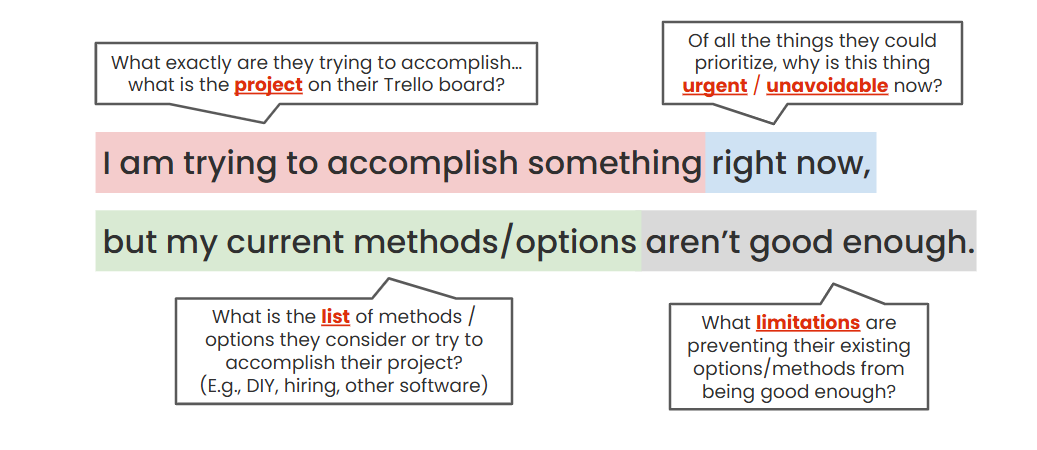
Before this unfolding, Goldcast’s PULL was:
If you are a B2B marketer running events and webinars, but you are coping with your traditional webinar platforms (for a few reasons), we offer a virtual events and webinars platform that’s specifically made for B2B marketers.
After this unfolding, Goldcast’s PULL become:
If you are a B2B marketer producing video content, but you are coping with your traditional video tools (for a few reasons), we offer a video content platform that’s specifically made for B2B marketers.
You can see the pressures that forced them to unfold in some direction. They weren’t growing fast, thanks to SaaS and post-COVID headwinds. But there were many potential directions they could have unfolded - into in-person events, for example. They had an intuition that going the “AI + video content” direction was right, but just this subtle-seeming unfolding had a ton of downstream implications. They had to figure out product-led growth, add a bunch of features, convince their 100+ person team they were right, and grind their teeth for a year while hoping they were making the right bet. It wound up working, and they grew fast while everyone else in the category was getting bludgeoned, and then Cvent came inbound. As Palash says, “Companies are bought, not sold.” Acquisitions follow the PULL framework, then; doesn’t everything?
One thing that is easy to overlook in Goldcast’s unfolding journey is that their source of inspiration came from observing their most successful (“hell yes”) customers… it did not originate from the boardroom or on a whiteboard. That is how it always seems to happen.
Anyway, that’s my take. Listen to the full episode, I think you’ll enjoy it. Let me know what you think!
Probably my favorite professional achievement of my adult life is that this quote is still funny, but no longer true.
Always gems