
Exponential PULL
Demand intensity is counterintuitive
Pre-order my book, The Power of PULL - it’s coming out July 7!
This week’s podcast:
Everyone, I think, should use the PULL framework:
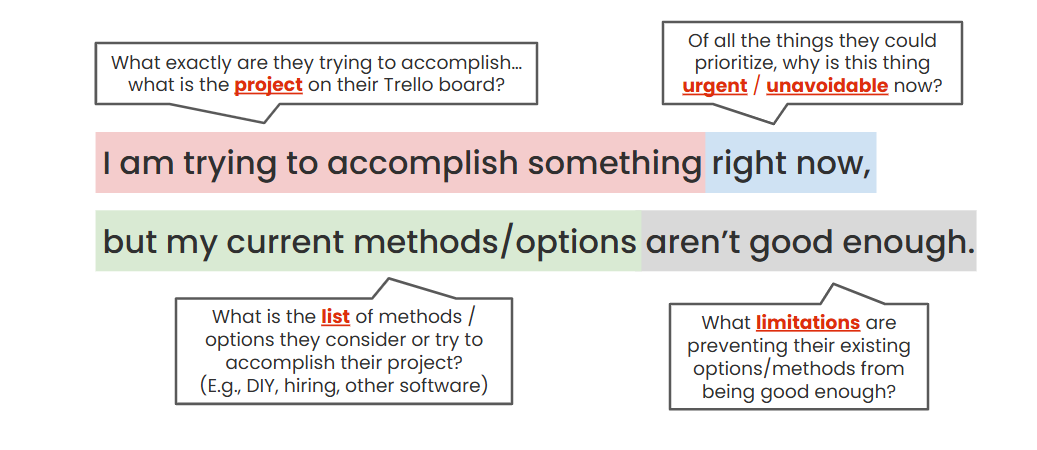
This is a way to describe a person who has a need and will purchase something that “fits” the need. If they have this need, and you show up with this:
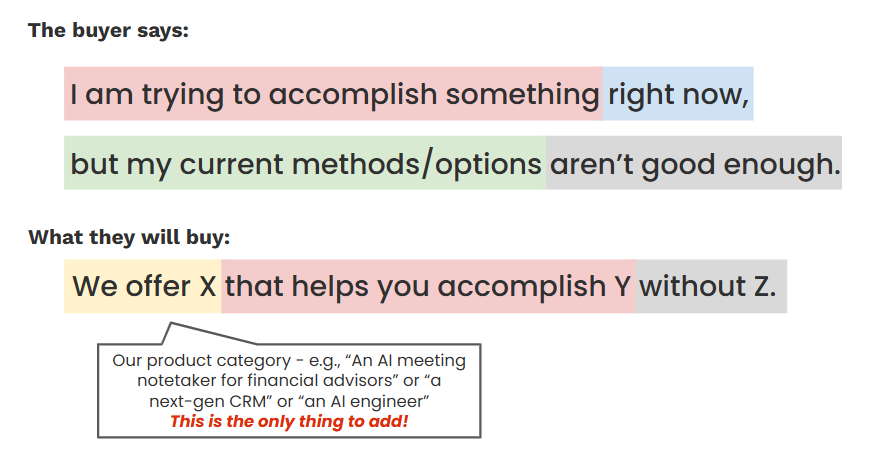
They should pull your product out of your hands.
Anyone who buys anything has PULL. If they didn’t have PULL, they (1) wouldn’t have bought anything, or (2) would have bought something else.
But: If PULL is present every time someone buys something, why do some companies grow super fast and others don’t?
I think it is about the intensity of PULL.
Any purchase takes some amount of effort to happen, then some amount of effort to use the product. This effort is split between the buyer and the seller.
High-intensity PULL means the buyer is putting in most, if not all, of the effort pre- and post-sale: The buyer is “spring-loaded”; they rip the product out of the seller’s hands.
As we move away from high-intensity PULL, the seller has to expend an increasing share of the energy to get the purchase done. The seller has to push, in other words.
In your mind, you’re probably picturing a scale that goes from no-intensity PULL to high-intensity PULL.
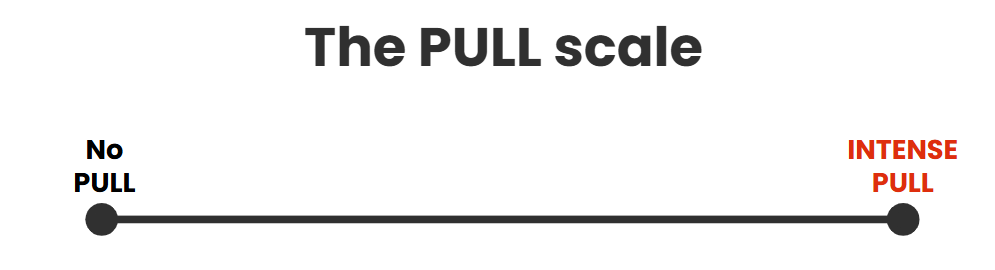
No-intensity is the absence of PULL. They aren’t prioritizing this right now, or their existing options are fine. The buyer is expending zero energy on this; the seller can expend infinite energy and the buyer still probably won’t buy.
High-intensity is the extreme presence of PULL. Where someone literally rips the product out of your hands, buys it as if it is absolutely irresistible.
Now, here’s the interesting thing about this kind of intensity scale: We tend to think it’s linear - that there are a sequence of steps between no-intensity PULL and high-intensity PULL, and there are equal units between each step. Like this:
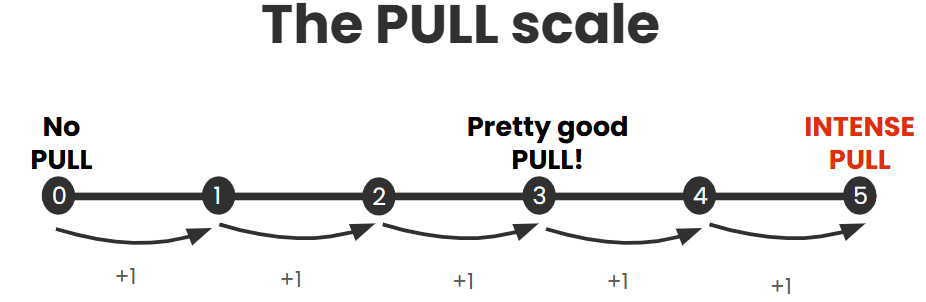
If 5 is “high-intensity”, a 4 is pretty darn good, it’s at “pretty-high-intensity”! A 3 is “moderate intensity” - not bad either! We might not blitzscale to $100M in 14 hours, but we can grow a solid business in a 3 or a 4 intensity.
This, I think, is wrong.
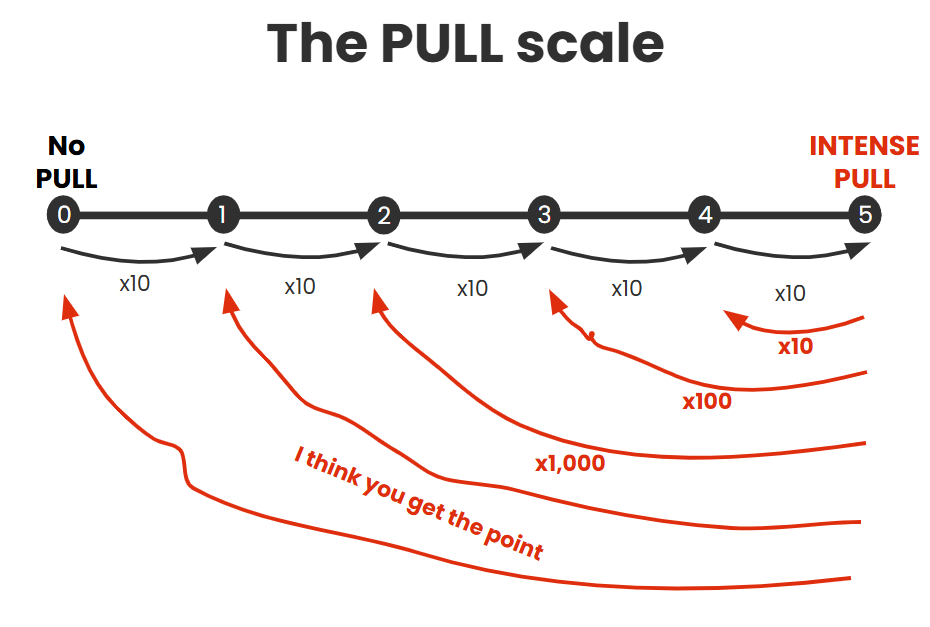
I have been comparing a bunch of startups’ journeys to try to figure out why one takes off, and another - with an equally good team - grows slowly. In doing this, I am fairly convinced that PULL intensity is not on a linear scale. It is on a logarithmic scale, like the Richter scale for earthquakes. If it’s a scale out of 5, a 5 represents 10x more intensity than a 4, and 100x more intensity than a 3.1
In other words, it looks like this:
This is really, really important.
Why this matters
If PULL intensity is logarithmic, then a seller has to do ~10x more work to get each customer to buy and become successful for each step down the intensity scale.
This explains this thing I keep seeing, which is that it is easier to build a super-fast-growing startup than a slow-growing one. Fast-growing startups’ engines are mostly powered by their customers’ energy. This makes up for the startup’s sins - they can be a clown car because they’ve fallen into a gold mine. And then, because these startups are fast growing, they can attract great talent and tons of capital as needed, which helps them move heaven and earth to serve the intense PULL they’ve found.
On the other hand, slow-growing startups aren’t powered by intense PULL, which means the startup’s employees have to expend exponentially more energy per customer than a startup that’s found intense PULL. They have to get everything right - their sales process, their delivery process, etc. - and it’s still hard. Hence why you see very accomplished serial founders assembling great teams, brute forcing their way to millions in revenue but unable to really scale something massive. They just haven’t found intense PULL.
Self-diagnosis… and what to do
Here’s how you can tell the intensity of PULL: What happens in your sales calls?
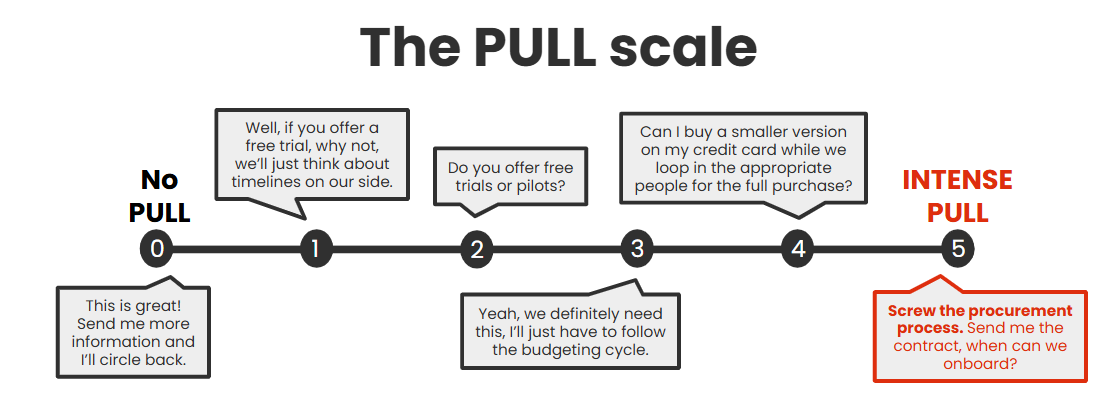
This is an example for a larger organization - but the point is, how much force do they exert to buy? Who do they run over?
So… what do you do with this information?
It would be amazing if we could all just start out on day 1 having found intense PULL. Some people do that - they just find something and BOOM. Maybe it’s luck, maybe it’s skill, all I know is it kinda makes me hate myself.
I have never been in that situation, nor have the overwhelming majority of founders I know. We usually start with low-PULL or no-PULL and can’t get anyone to buy. Or we get somewhere - $100k, $500k, $5M even - with moderate PULL, but it still feels like we’re pushing.
But in basically all cases, there are clues of possible intense PULL - for example, one customer buys weirdly fast. Or someone really leans in at one part of a sales call - “wait, you can do WHAT?”
A founder’s job is to take those clues and form them into a new PULL hypothesis. Then unfold towards intense PULL. This might require changing ICPs, messaging, or something more dramatic.
But I hope you can see now - this is the whole game!
PS:
Everything comes together in your sales calls - PULL intensity, product-market fit. Most founders are using outdated tactics and frameworks in their sales calls, which prevent their startups from from reaching their true potential.
Founders pull me in to help them perfect their sales calls. My revisions have led startups to go from $0-$25M ARR in 2 years, $0-$6M ARR in 8 weeks, and rapid acceleration for companies ranging from $100k - $20M ARR.
Send me a few of your sales calls, and I’ll diagnose what isn’t working and fix it with you. Learn more and reserve your slot here.
It might not be a log10 scale, but it is also definitely not linear.
"this is the whole game!" <- the Zen of startups would say before enlightenment, talk to customers and iterate on pull, after enlightenment talk to customers and iterate on pull.
Totally agree on the product-market-fit lever being exponential. But 10x vs 100x "PULL" kind of misses the important math.
In Major League Baseball, a 90mph fastball is whiffed 15% of the time. But a 100mph fastball is whiffed 36% of the time. 10pmh more fastball = 140% more whiffs. Similar to sales, there's going to be some bounding/diminishing return from having a better and better product. At some point, you win the deal or you don't, and it's about winning more often.